Category Archives: Uncategorized

A Meaningful Mission

 Image

It is amazing how one person’s life can directly impact the lives of countless others.  If you remove one person from existence, you will not only lose all of the contributions that person could make but also all of the contributions their descendants could make.  There was once a young World War II naval aviator who narrowly escaped death on a Pacific island.  Had he died on that island, he would have had no children and two men who became President would never have served.  He was George Herbert Walker Bush, the forty-first president, and the father of George Walker Bush, the forty-third president.  This is the remarkable story of his survival and the impact it still has today.

Like President John F. Kennedy, who also served in World War II, George H. W. Bush was born into a wealthy and influential family.  His father was a managing partner for America’s largest private bank, and his grandfather was the namesake for the Walker Cup, the international golfing competition’s award.  To prepare for his apparently bright future, he first attended Philips Academy in Andover, Massachusetts, after which he planned to attend Yale.  The attack on Pearl Harbor changed all that.  Instead, on his eighteenth birthday, Bush enlisted as a naval aviator — the youngest ever at the time.  After training, he was assigned to the crew of the aircraft carrier, USS San Jacinto, flying the TBM Avenger.  He would fly a total of fifty-eight combat missions carrying torpedoes and bombs, but none compared to the one over Chichi Jima.

On the morning of September 2, 1944, 20-year-old Lt. j.g. George Bush received his orders for the day.  He was to be part of the attack on the radio station on the island of Chichi Jima, located only 600 miles from Japan.  The island’s communications center was a crucial link in Japan’s early detection and warning system.  Unknown to Bush at the time, eight Navy and Marine flyers would eventually be shot down over that very island.  Each of them disappeared without a trace, never to be heard from again.  Investigations after the war’s end left the families and friends of the crewmen without answers as both the American and Japanese governments worked to cover up what happened on Chichi Jima.  Even so, there would remain unconfirmed reports and evidence that Japanese soldiers committed acts of cannibalism involving the eight flyers.  Chichi Jima was not a place where an American wanted to be captured.  Regardless, this was the young lieutenant’s next mission.  

At two months past his twentieth birthday, George had already seen his share of action, including one sea ditching.  On this strike he and his two crewmen, a radioman and a gunner, would deliver four 500 pound bombs through the same flak filled skies to try to take out the same radio station he had attacked the previous day.  Antiaircraft artillery (AAA) surrounded the target.  The squadron of aircraft began their attack, and the Japanese gunners opened fire.  The first two planes successfully dropped their munitions on the complex of antenna towers and transmitters.  Now it was George’s turn.

Bush pushed his Avenger into a steep dive as he began his bombing run.  The Japanese, however, had found the correct range.  AAA shells burst all around him.  Just as he was about to release his bombs one of those shells tore through Bush’s plane.  The cockpit filled with smoke, and flames ran along the wings toward the fuel tanks.  Bush did not panic; instead, he steeled his nerve to finish his mission.  He continued on course, made final corrections, released his bombs, and scored direct hits on the target.  Now it was time for him to escape.

Bush turned out over the ocean.  The plane, now entirely enveloped in smoke and flames, lost even more altitude.  He maneuvered his aircraft in a manner that would allow his two crewmembers an easier escape and commanded a bailout.  George then unfastened his seatbelt and dove out.  In the process, he gashed himself above one eye and tore out some panels on his parachute.  He slammed into the ocean below, just as the plane exploded above him.  Once in the water, George unbuckled his parachute and swam to a raft, anxiously searching for his fellow crewmembers.  Neither of them made it.  George himself was in bigger trouble than he realized. 

Only four miles from Chichi Jima, the current was pushing him toward it.  At the same time, excited Japanese soldiers launched several small boats, intent on capturing the young lieutenant.  Once in Japanese hands, Bush might never return home alive.  Fortunately, two of his fellow attackers saw the danger and strafed the Japanese boats, forcing them to retreat — for the moment.  Soon low on fuel, the planes turned back toward their aircraft carrier.  Their departure left Bush alone in the raft and drifting dangerously close to the island.  He paddled, prayed and hoped.  He recalled seeing a photo of an Australian pilot who was beheaded by the Japanese.  He prayed again that he would survive.  Miraculously, he did.  One of the planes had radioed his position to an American vessel about 20 miles away.  Three hours later, the huge hull of a submarine, the USS Finback, surfaced near him, and the crew pulled Bush from the raft to safety.

If not for that submarine, George Bush would simply have been the ninth American flyer lost on Chichi Jima.  Instead he survived to live an extraordinary life.  After a month on the submarine, he returned home where he was awarded the Distinguished Flying Cross for his actions at Chichi Jima.  Bush later recalled that during the month he spent on the USS Finback following his rescue, he had time to reflect on his ordeal.  He experienced a deep and profound sense of gratitude to God for sparing him and understood that he was spared for a reason — God had something in store for him.   

After the war, Bush graduated from Yale, pursued the oil business in Texas and enjoyed a phenomenal political career.  He served as congressman, ambassador to the United Nations, ambassador to China, director of the CIA, vice president, and finally as the forty-first president of the United States.  He also lived to see his son, George Walker Bush, become the forty-third president of the United States.  From his days as a young naval aviator to his time as president, the impact of this one life has been remarkable.  None of it would have ever happened had that meaningful mission turned out differently.    

4 Comments

Filed under Uncategorized

The Call of Duty

Image


Would you continue in faithful service to a cause that you knew was doomed?  Many people would likely consider it foolish.  To my mind it demonstrates a true commitment to something higher than yourself.  In a word, duty — fulfilling the obligations you have undertaken.  In the final days of the American Civil War, the South’s greatest general saw defeat looming ahead but refused to abandon his duty.  He was General Robert E. Lee of the Army of Northern Virginia.  This is the story of his faithful service — to the very end.

Robert Edward Lee was a true son of Virginia with a proud heritage.  His father was “Light Horse Harry” Lee, one of George Washington’s top cavalry commanders, and his wife Mary Custis Lee was none other than the step-great-granddaughter of George Washington.  From his earliest days there had been instilled in Robert the highest virtues of his day — duty, honor, loyalty.  He attended the United States Military Academy at West Point and served in the U.S. Army for over thirty years.  It was a different age, however, and Lee believed his first loyalty was to his native Virginia.  So, despite his long service and allegiance to his country, when Virginia seceded from the Union in 1861 and issued her call to arms for her sons, he somberly resigned his Army commission and put on the uniform of a Confederate general.

After a year of service in various military capacities, he assumed command of the Army of Northern Virginia, ultimately becoming the Confederate general-in-chief in early 1865.  He became the most beloved commander on either side of the struggle.  Outnumbered and outgunned, he tirelessly served the Confederacy through both stunning victories and devastating defeats.  As the years wore on, however, the tide of war turned in favor of the Union.  Lee knew the end was close.  Through it all, General Lee understood his duty.  As head of the Southern forces, he accepted the weighty obligation to fight on until the South’s civilian leadership said otherwise.

Confederate President Jefferson Davis had not said otherwise, and the Union forces pushed toward a final showdown.  That final struggle began on April 2, 1865 in Petersburg, Virginia, only twenty-three miles from the Confederacy’s capitol of Richmond.  After nine months besieging Lee and his entrenched army, Union forces under Ulysses S. Grant broke through the Confederate defensive fortifications.  Lee was left with no choice but to order the evacuation of his army and the Southern government.  Union forces captured Richmond the next day.  Even though the end was near for the South, Lee would not give up.  He would not give in.  He would continue to do his duty.

General Lee never forgot that he had a duty to his country, but he also fully understood that he had a duty to his men.  He believed that duty to both required him to make an attempt at escaping the pursuing Union soldiers.  His plan was to march to a nearby railroad station to obtain provisions before marching to North Carolina to link up with the Confederate Army of Tennessee, the other surviving Southern army of importance.  When he and his soldiers reached the station, however, they found ammunition instead of food.  One Confederate officer reported that the sight paralyzed Lee with shock.  Seeing his soldiers’ near starvation, Lee sent wagons out into the countryside, but they returned with only meager amounts.  Distributing what was available, Lee ordered his men to continue their march west to get around the surrounding Union forces.  Then came April 6, 1865.

Knowing that he owed it to his soldiers to continue the retreat, he had the Confederate cavalry seize control of two Appomattox River bridges.  He had other parts of the army continue to move west.  In the early afternoon, some units reached a small stream called Sayler’s Creek.  Unexpectedly, they found themselves facing a strong force of Union cavalry and infantry.  The Union forces immediately engaged the Army of Northern Virginia.  The Confederates fought back with fierce determination, for they were fighting for their lives.  Fierce determination could not overcome superior numbers though.  Hungry, tired, without sufficient ammunition and in the face of annihilation, the Southerners ran for their lives as Union forces closed in around them.  Nearly six thousand soldiers were captured, including eight generals.

As the survivors made their way up the creek bank, they found General Lee sitting on his horse, Traveler, watching the disastrous collapse.  Turning to one of his subordinates, Lee gasped in horror and whispered, “Has the army been dissolved?”  It certainly appeared that way.  Many of the surviving soldiers gathered around Lee and looked to him as a child would to a beloved parent for comfort.  “Marse Robert,” as his soldiers affectionately called him, understood he still had a duty to bolster his soldiers’ spirits.  Seeing a discarded Confederate flag lying nearby, Lee grabbed it and waved it above him.  As he did so, the wind blew hard and fully unfurled the flag.  The sight seemed to reinvigorate the men’s willingness to follow him to the end.

At this moment, the darkest point yet in his years of service, the end seemed inevitable.  Lee asked one of his officers what the country would think of him if he surrendered.  The officer responded that Lee had become the country to his soldiers, meaning that their only allegiance was to Robert E. Lee himself.  He led his men west for two more days, even as Ulysses S. Grant sent messages advising him to surrender.  Then on the morning of April 9, 1865, Palm Sunday, General Lee and the Army of Northern Virginia found themselves surrounded by Union forces near Appomattox Court House.  To continue to fight would only result in the army’s needless slaughter.  He knew there was no alternative, and there was no honor in sacrificing more lives.  He owed it to his soldiers.  The idea of surrender made him heartsick though.  It is reported Lee said to one officer, “There is nothing left for me to do but go and see General Grant, and I would rather die a thousand deaths.”  His duty to his country completed, his duty now consisted entirely in protecting his men.

As part of the terms of surrender, Lee ensured his soldiers could go home without fear of imprisonment.  The officers could keep their weapons, and both they and those in the cavalry and artillery could keep their personal horses.  They also kept their honor.  The beloved general urged his soldiers to go home and become loyal citizens in their once again united country.  He himself became president of Washington College in Lexington, Virginia.  It was later renamed Washington and Lee University.  Lee would die just five years after the war ended. 

Throughout the war, and especially by his actions in the last days, Robert E. Lee always strove to do his duty as he saw fit.  He faithfully served the Confederacy and his men until the end.  He famously said, “Duty is the sublimest word in the English language.  Do your duty in all things.  You cannot do more.  You should never wish to do less.”  Still memorized today by those young Americans who attend the country’s top military academies, this quote reflects a core principle of those who serve their country and perfectly sums up the life of the man who said it.

1 Comment

Filed under Uncategorized

A Revolutionary Miracle

Image

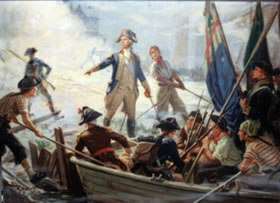
Miracles do happen.  Sometimes we may not call them that or even recognize them as such — but they do, indeed, occur.  God simply reaches down and directly intervenes in our lives.  Several years ago, there was an incredible story of how an airline pilot landed his plane on the Hudson River in New York City and saved the lives of all of the people onboard after a flock of birds flew into the engine and damaged it.  Everyone called it “The Miracle on the Hudson.”  Surprisingly, one of the most dramatic examples of a miracle in our history happened in that same city during one of the great battles of our War of Independence.  This miracle, like the water landing, saved many lives, but even more importantly it saved George Washington’s Continental Army and, in fact, the American Revolution.  Like many miracles, it may sound unbelievable, but this “Miracle on the East River” really happened.

The story begins in the early days of the American Revolution just over a month after the signing of the Declaration of Independence when the very survival of the new nation was in doubt.  The Continental Army was poised for battle against British forces on that part of Long Island now known as Brooklyn.  Determined to smash the revolt quickly, on the night of August 26, 1776, British soldiers marched around the American left flank using an unguarded road called the Jamaica Pass.  The following morning, August 27th, the British attacked and routed the Continentals.  The Americans retreated in chaos and disorder to their fortifications on Brooklyn Heights above the East River.  There, under George Washington’s leadership, they reorganized and held their position for the following two days.

The British generals believed that victory was inevitable, so they did not press the attack; rather, they were content to wait until the British fleet closed the back door on the East River.  On August 28th rain and stormy weather began with a strong wind from the northeast, keeping the British ships from blocking the river.  With his men trapped between the Redcoats in front of them and the East River behind them, Washington realized that his position was indefensible.  The question was how to save his army.  He needed to find a way to ferry all nine thousand of his soldiers across the river to the island of Manhattan and from there further inland to safety.  There were no bridges like today, and the only available means of transport were small boats that would have to be rounded up.  Washington issued orders for all of the boats to be gathered along the banks of the heights.  As night fell on the 29th, the wind, tide and rough water prevented the small boats from beginning the evacuation.  Fortunately, it also kept the British warships away as well.  But, time was running out on the Americans.

With Washington and others beginning to think there would be no retreat that night, at about eleven o’clock the northeast wind suddenly died down.  Then, as if told to do so, the wind shifted to the southwest — part one of the “miracle.”  The crossing began.  The small armada of boats manned by sailors and fishermen started ferrying the soldiers to the opposite shores of Manhattan.  Under strict orders to maintain silence, the American troops kept the British from detecting their escape.  The boats went back and forth all night, but it was slow work.  As morning began to dawn, there were still hundreds of American soldiers waiting on the Brooklyn side of the East River, including George Washington himself who had stayed behind to help direct the crossing.  Soon the British ships would arrive to cut off the retreat and a slaughter in broad daylight would begin.  It was at this moment that part two of the “miracle” happened.

Just at daybreak on August 30th, a fog as thick as pea soup began to lay across Brooklyn and the river, masking the continued crossing.  No one could believe it, but the fog kept the British soldiers from discovering what the Americans were up to.  When the American soldiers reached the Manhattan side of the river, they saw that the fog lay only on the Brooklyn side of the river.  As the last of the Americans were preparing to leave, the British soldiers began to move forward.  They stared in complete surprise at the empty American fortifications.  In the last boat was George Washington, the American Commander-in-Chief.  With the others in the boat, he watched the Brooklyn side of the river and the stunned British soldiers standing at the edge of the river slowly fade from sight.  He and his entire army had escaped.

Some people have called Washington’s escape “fate” or “luck;” others have attributed it to the circumstances of Mother Nature or the hesitation of the British to press the attack.  It has often been called “Providence.”  I personally believe that it was the direct hand of God who intervened favorably on behalf of George Washington and the American soldiers.  I believe it was He who, through adverse winds, kept the British fleet from entering the East River; I believe it was He who changed the winds to allow the crossing; I believe that it was He who laid down the blanket of fog at the critical moment; and I believe that it was He who kept the retreat from being detected by the thousands of British soldiers and sailors all around the Americans.

Regardless of what you may call it, in one night nine thousand American soldiers escaped across a treacherous river in small boats without the loss of a single life.  Our Commander-in-Chief and his army went on to fight for the next seven years until they achieved victory and freedom.  I will always call it “The Miracle on the East River.”

1 Comment

Filed under Uncategorized

An “Ordinary” American Hero

Image


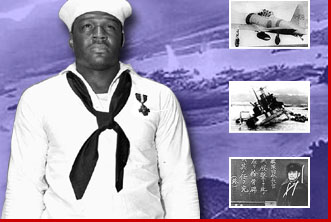
Many individual Americans live their lives believing they will have little impact beyond their immediate family and friends.  Oftentimes however, ordinary people have been summoned to act in extraordinary manners.  On December 7, 1941, many young Americans were called on to act.  Among those to answer the call, one ordinary African-American stood out for his courageous response.  Despite his humble beginnings, this young black man gained an honored place in America’s pantheon of heroes.  His name was Doris “Dorie” Miller.  He was the cook who took on the Japanese Empire.

Like many African-Americans of his generation, Dorie Miller was born the son of poor sharecroppers.  His early years near Waco, Texas were spent shifting between school, where he excelled in athletics, and work on the family farm.  He wanted more out of life however; so, at age nineteen he enlisted in the United States Navy.  Because of military regulations limiting the opportunities for minorities at the time, Dorie worked as a cook and mess attendant, performing various menial jobs.  After serving on several ships, he was transferred to the battleship USS West Virginia, part of the United States Pacific Fleet stationed at Pearl Harbor, Hawaii.  In spite of his being a cook, Miller quickly gained fame as the ship’s heavyweight boxing champion, standing six feet, three inches tall and weighing two hundred and twenty-five pounds.  Then came the day that changed America, and Dorie Miller’s life, forever — December 7, 1941, “a date which will live in infamy.”

As the day dawned, it appeared to be a typical Sunday morning in Hawaii.  Almost the entire Pacific Fleet was at anchor in the harbor.  Seven battleships, the deadliest U.S. ships afloat, were moored along “Battleship Row” on the east side of Ford Island.  Many crewmembers were still asleep in their bunks.  As was true of most mornings, Miller was finishing preparations for breakfast and seeing to the officers’ personal needs when the first wave of two hundred Japanese planes appeared.  The Japanese radio operators would later transmit the code “Tora, Tora, Tora” to indicate they had achieved complete surprise.  As they roared over the harbor, the attackers unleashed their bombs and torpedoes on the unsuspecting armada.  Within minutes, some of the grandest warships of the Pacific Fleet were in flames and sinking to the bottom of the shallow harbor.  A number of the first wave turned their sights on the West Virginia.  Soon that ship too was sinking from multiple bomb and torpedo hits.  

As sheer chaos and mass destruction descended around him, Miller hurried to his battle station in the anti-aircraft magazine, the ammunition hold, only to find it destroyed by a torpedo.  Rather than panic or jump overboard like some of his shipmates, Dorie remained calm and began picking up injured sailors and carrying them to safety on the quarterdeck.  He even attempted to move a mortally injured Captain Bennion, the West Virginia’s commander, from the bridge, but the captain refused to leave his post and soon died of his wounds.  After attending to his stricken commander, Miller left the bridge and moved on to assist in the loading of another of the ship’s anti-aircraft machine guns.

Being African-American, Dorie had not been allowed to train with the machine guns, but he had watched others load and fire them during the many drills held onboard ship.  Now, with the battle raging around him, Dorie determined to do more than simply assist others.  Racing to an unmanned gun, Miller took his position behind the gun and began firing.  He pulled the trigger and swiveled the gun back and forth in an effort to track attacking aircraft.  His aim was deadly.  A Japanese Zero plummeted into the oil-slick waters of the harbor only seconds after he began firing.  Others followed as he blasted away.

Miller fired the machine gun for a total of fifteen minutes.  Accounts vary but some eyewitnesses to the action later credited him with shooting down as many as four Japanese planes.  Even as he fired the machine gun, the West Virginia continued to sink from under him.  Eventually, Dorie and the other survivors had no choice.  He left the machine gun under orders to abandon ship, jumped into the oily, debris-strewn harbor, and swam towards shore.

Word soon spread of the courageous exploits of the young African-American cook.  The American public instantly hailed him as a hero and celebrated his achievements.  For his actions, Dorie received letters of commendation from President Franklin D. Roosevelt and the Secretary of the Navy.  He also received the Navy Cross, the U.S. Navy’s highest award after the Congressional Medal of Honor.  At the ceremony, Pacific Fleet Admiral Chester Nimitz, like Miller a native Texan, praised him “for distinguished devotion to duty, extraordinary courage and disregard for his own personal safety.”  On a brief visit home in early 1943, Dorie told his mother his prayers had not been forgotten — that it was God’s protective hand that kept him from being shot or blown to pieces that day.

Dorie would not remain out of action for long.  He returned to sea duty in mid-1943 aboard the escort carrier USS Liscome Bay.  A few months later, on the day before Thanksgiving 1943, the ship was torpedoed by a Japanese submarine and sank in the central Pacific.  Sadly, Dorie Miller was one of the six hundred and forty-four men onboard who were killed in action.  America would always remember him though for his actions on one of the country’s darkest days.  On December 7, 1941, an “ordinary” American named Doris Miller acted in an extraordinary manner and inspired a country. 

2 Comments

Filed under Uncategorized

A Lady’s Legacy

Image


Never underestimate the significance of a national symbol or the risks that must be taken at times to preserve it.  There was once an American woman, the First Lady no less, who understood what the loss of an American symbol could mean for the country’s morale.  To prevent such a catastrophe, she willingly risked her life to safeguard that symbol.  For that action, she deserves the eternal thanks of a grateful nation.  She was First Lady Dolley Madison.  This is the tale of her selfless rescue of President George Washington’s portrait from the hordes of British invaders during the War of 1812.

 As the oldest daughter of a Quaker Virginia planter, Dolley Madison grew up on her family’s plantation in northern Virginia, where she learned the social etiquette that was required of young ladies of the day and which served her well as First Lady.  At age fifteen, she moved with her family to the temporary American capitol of Philadelphia.  There she grew into womanhood, married her first husband, and bore two children before losing her husband and youngest child to disease.  As she struggled in the aftermath of her husband’s death, she found a new life with her second husband, James Madison, the “Father of the Constitution.”

James Madison later became the fourth President of the United States, and the two moved to the new, unfinished capitol of Washington, D.C.  Their home, the Executive Mansion, was simply known as the President’s House in those days.  Dolley shined as the First Lady, but it was her actions in August of 1814, two years after America went to war a second time with Britain that cemented her reputation as a true American heroine. 

After two long years of fighting the strongest military in the world, the new capitol of the young United States was under direct attack.  On August 23, 1814, President James Madison dashed out into the countryside to inspect the defensive fortifications around Washington.  That same day the few remaining soldiers guarding the President’s House also departed.  With only the household staff remaining, Dolley feared for James’ safety but resolved to wait for his return so they could flee together.  As she waited, she fulfilled his parting wish by loading the most critical government documents into enough trunks to fill her carriage.  She also packed a wagon full of the Executive Mansion’s valuables.  The wagon would travel into the nearby countryside.  The work continued into the next morning, August 24th.  As they were working, word arrived that the British Army had routed the American Army and was only miles away from the city itself.  Dolley ignored the approaching danger and continued her efforts to save items of critical importance.  Suddenly, she realized that there was one precious national treasure still at risk. 

Hanging on the wall of what is today the State Dining Room was a large canvas portrait of President George Washington by the artist Gilbert Stuart.  It depicted Washington not as a military leader but as an American citizen whose ultimate desire was to serve and preserve his country.  To Dolley Madison, and to the nation, that portrait not only represented the “Father of Our Country” but also served as one of the symbols of the new republic.

Dolley implicitly understood that if the British soldiers took the President’s House they would undoubtedly deface the painting in order to humiliate the United States.  She resolved to not give the British the opportunity to demolish such a symbol.  She ordered the household staff to haul the painting down, but they found it had been screwed into the wall.  As the feverish evacuation continued, Charles Carroll, one of the original signers of the Declaration of Independence, arrived to help with the removal of the government documents and to escort Dolley out of the city.  He was stunned to find her standing in the hall.  Despite his arguments, Dolley refused to leave until the painting was safely removed and protected.   

Knowing their window of opportunity for escape was closing, one of the staffers climbed on top of a ladder and used his pocketknife to deftly cut the painting out of its gilded frame; then he quickly rolled up the canvas.  The painting was carried outside and placed in a waiting wagon driven by two New Yorkers.  Dolley monitored the loading before she too climbed into her private carriage filled with the trunks of government documents.  Dolley then gave orders for the portrait to be hidden in the countryside until after the British left Washington.  Understanding the symbolic value and showing her fierce dedication to the end however, Dolley insisted that the painting be destroyed if it appeared in jeopardy of being captured.

All possible precautions now taken, Dolley and Charles Carroll hurriedly drove the carriage out of town.  A short time later, the vanguard of the British Army entered the main part of the city.  Soldiers ran riot as they looted the homes of America’s political leaders.  British officers established their headquarters in the President’s House and enjoyed a lavish meal that Dolley had previously prepared.  Then they set fire to both the Executive Mansion and the Capitol Building in a display that was seen for miles.  Much of the city was burned and with it many of the symbols of the new republic.  But not everything.  The famous portrait of our greatest President was saved from the destruction. 

Like the building that housed Washington’s painting, the United States ultimately survived the British invasion.  Dolley and James Madison returned to the Executive Mansion to find a burned out shell in its place.  They immediately began to restore the building.  To hide the fire damage, the mansion was given a new white exterior, thereby providing the home with a new name, the White House.  George Washington’s painting also returned to those hallowed halls and now hangs in the East Room.  Thanks to the fearless spirit and dogged determination of a patriot named Dolley Madison, one of our country’s truly inspirational symbols continues to look down through the ages to inspire Americans even today.  

2 Comments

Filed under Uncategorized

Win or Sink

Image


There are times in virtually every life when things seem hopeless, when one is tempted to give up.  Such times reveal a person’s true character.  No story illustrates this better than the true-life tale of an American Navy captain’s cry of defiance during a desperate battle for American independence.  His cry echoes down to us through the centuries and inspires us even today.  The captain’s name was John Paul Jones, and he proved to his fellow countrymen that Americans should fight to the very end, even against impossible odds.

John Paul Jones was born in Scotland, but at age twelve he exchanged his life on land for a life of adventure on the seven seas.  As a young cabin boy, he made his first journey to the land called America.  Years later, seeking sanctuary after killing a mutinous crewmember, the young Jones settled in America.  He quickly fell in love with the country.  At the outbreak of the American Revolution, he put his seagoing skills to use by joining the new Continental Navy.  As one of the country’s first naval captains, Jones led several successful raids against British coastal fortifications in an effort to draw British ships away from America’s coast.

In August of 1779, he assumed command of the Bonhomme Richard, a new ship honoring Benjamin Franklin’s Poor Richard’s Almanac.  Soon Captain Jones was back to raiding British towns, attacking British military and merchant vessels, and generally sowing panic among the British public.  Then came his greatest naval challenge.

On the night of September 23, 1779, the Bonhomme Richard was sailing along the coast of England when Jones caught sight of the new, powerful British warship, HMS Serapis, as it was providing escort for several commercial ships.  Seeing the American flag, the commercial vessels raced for the safety of the nearby British coast.  As the two warships approached one another, British Captain Pearson reportedly asked what the Richard was carrying, and Jones brashly replied “Round, grape, and double-headed shot,” intentionally provoking a fight.  The Bonhomme Richard then opened fire on the British ship.

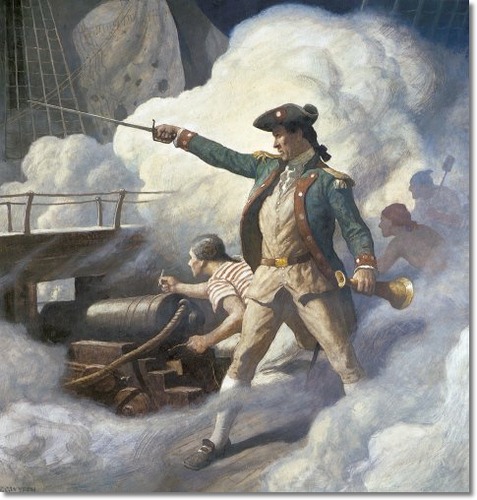
As explosions erupted on every side of him, Jones stood erect on the deck directing the fire of his gunners and exhorting his men to carry the fight to the enemy.  Jones felt shivers and heard rips as the Bonhomme Richard began to suffer direct hits to its masts and hull.  Both the Bonhomme Richard and the Serapis continued to close the gap as their cannons blasted away at each other.  Then in an instant, the topsides of the two ships became intertwined with one another.  The result was that American sailors had to actually lean over into the British ship in order to load the cannons and ignite their fuses.  As dozens of their comrades fell around them, the remaining American sailors continued to pound away at the enemy.  It soon became apparent, however, that the Bonhomme Richard was starting to sink.

To any experienced naval man, the outcome was obvious.  The British captain was such a man.  Seeing the extensive damage his cannons had done to the Bonhomme Richard, Pearson shouted across to Jones, “Will you lower your flag in surrender, sir?”  Standing on the deck with seawater literally lapping at his boots, fires raging all around him, and many of his sailors lying dead and wounded on the deck, Captain John Paul Jones defiantly answered back with some of the most famous words in American memory.  “No, sir,” he replied, “I have not yet begun to fight!”  To him, the choice was clear — either win or sink.  Not only that, but then Jones boldly asked the British captain if he wished to surrender.

The Serapis had taken severe damage to her deck and sails.  Finally a well-placed shot from the Bonhomme Richard toppled the mainmast, and it was evident that the British ship could not endure any more damage.  Unwilling to lose his own ship, Captain Pearson personally went over to the mast and hauled his flag down to show his capitulation.  John Paul Jones had won a great victory for his struggling country.  Despite their best efforts, however, he and his sailors could not save the Bonhomme Richard.  So he ordered all hands to board the Serapis, the ship they had just defeated, and they watched as their own ship finally sank beneath the waves.

Though his ship now lies at the bottom of the Atlantic Ocean, the immortal words of John Paul Jones, “I have not yet begun to fight!” live on forever.  His defiant cry not only gave inspiration to sailors and officers in his day but also continues to do so today.  The words live on in the naval traditions imparted to each cadet who attends the United States Naval Academy in Annapolis, Maryland, where the heroic captain now honorably rests.  Captain Jones’ legacy and his message to us is this — even in the face of impossible odds and even when everything screams at us to surrender…Never Give Up!


4 Comments

Filed under Uncategorized

Courage and the Coconut

Image

One of the most important characteristics a person can demonstrate is courage in the face of adversity.  A Senator from Massachusetts once penned a Pulitzer Prize winning book on the subject, Profiles in Courage.  He knew a little about that trait himself.  I am speaking of President John Fitzgerald Kennedy.  As a Naval officer in World War II, Kennedy displayed not only true courage but also resourcefulness in getting himself and his crew rescued from a deserted Pacific island.  A simple coconut was the key.  Today, that coconut holds an honored place in the John F. Kennedy Presidential Library and Museum in Boston, Massachusetts.  Hear the amazing, yet true, story of John F. Kennedy and the coconut that saved his life.

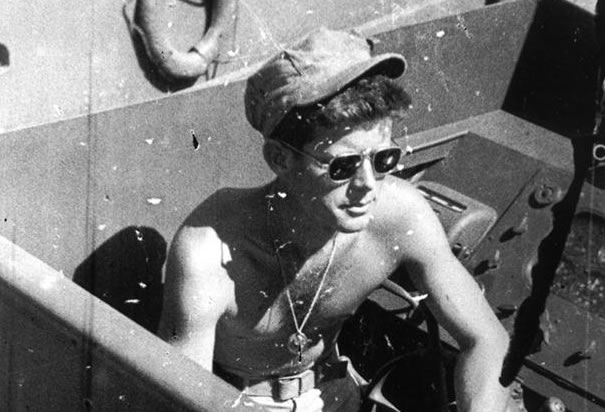
John Fitzgerald Kennedy, affectionately referred to as Jack by his family, belonged to one of the richest families in America.  Despite such privilege, he desired to serve his country when World War II broke out.  With assistance from his influential father, a former American ambassador to Great Britain, Jack became the commander of a small patrol boat, PT-109, in the South Pacific Ocean.  The boat’s mission was to seek out and destroy enemy Japanese ships. 

While on patrol on the night of August 2, 1943, however, a Japanese destroyer, the Amagiri, turned the tables on PT-109 when it appeared from out of the darkness and sliced through the patrol boat.  As his boat sank, Kennedy found two crewmembers dead and another two severely injured.  After drifting in the black ocean for several hours and waiting for an immediate rescue that did not come, Lieutenant Jack Kennedy concluded that he had to act decisively if he and his remaining crewmembers were to survive.  Seeing a nearby island, he determined the crew’s best chance was to swim for it.

Through the shock and chaos of the moment, he personally led the way to safety, even towing an injured sailor by clutching the man’s life jacket strap between his teeth.  He and the others finally made the three-mile swim to the one hundred yard long, sand and palm tree covered island.  As the men rested from their arduous swim, they knew they had no way to transmit their situation and location to their fellow Americans except with the small lamp they had managed to salvage from the boat.  As their commander, Lieutenant Kennedy understood that he had a duty to look out for his men and get them home safely. 

That night, the youthful PT commander risked his life again in a desperate attempt to contact any American forces that might be in the area.  An excellent swimmer, Jack swam far out into the ocean and waved the lantern in an effort to signal passing American ships.  To his deep disappointment, Kennedy found that there were no American vessels in the area that night.  He floated in the dark water for hours before the current turned him around and carried him back to the island.  Along with his fellow sailors, the previously pampered Kennedy spent the next several days choking down slimy snails for food and searching the skies for signs of an American rescue plane.  After four trying days, Jack determined to seek out rescue once again.  He swam toward another nearby island in an effort to contact anyone, native or otherwise, to help him and his men get off the island.

Jack Kennedy knew Japanese patrols were everywhere, but he was desperate to save his men, even if it meant risking capture.  After searching the island, Lieutenant Kennedy started to paddle back to his crew in an abandoned canoe when two local men found him.  There was no chance the two men could themselves rescue the whole crew.  In a burst of inspiration, Kennedy came up with the only unsuspicious thing available for the natives to carry with them to Americans on neighboring islands.  On a coconut, he carved a brief message detailing his name, his command, and his island location.  He was then able to make the natives understand the need to convey it to American forces.  The natives successfully evaded the Japanese, and they eventually delivered Lieutenant Kennedy’s coconut “letter “ to an American unit on a close-by island.  Rescue for John Fitzgerald Kennedy and the remaining crew of PT-109 soon followed. 

The story of John F. Kennedy’s bravery in getting his men to safety and his resourcefulness in using a coconut to communicate his rescue plea made him a national celebrity.  He came home to a joyous welcome by his family, friends, and a grateful nation.  After the war, Kennedy ran for Congress and won.  In 1960, he was elected the 35th President of the United States, the youngest man ever to be elected to that high office.  Jack never forgot how close he came to death during those dangerous days in the Pacific.  The coconut, which held a special place on his presidential desk, was a constant reminder of his own profile in courage.

3 Comments

Filed under Uncategorized

One Man Can

Image


We have heard it said that one person can change the world.  Let me tell you about a courageous man who was willing to act boldly in order to preserve the army, and the country, he loved.  By his actions, he very probably saved the United States from becoming a shadow of the great country it is today.  His name was Gouverneur K. Warren, and his story begins on July 2, 1863, during the American Civil War, near a small town in southern Pennsylvania called Gettysburg.

On that swelteringly hot July afternoon, Brigadier General Warren, serving as the chief engineer for the Union Army of the Potomac, was riding his horse near the southern perimeter of the Union line.  He was looking for signs that the enemy Confederate soldiers were about to attack the Union forces.  As he scouted the line, he was amazed to see a large group of Union troops moving aggressively toward a grove of peach trees and a nearby wheat field far in front of the Union Army.  He knew the soldiers did not have orders to move out that far, so he decided to explore the undefended area.

Reaching the area, he spied a high hill directly in front of him and immediately realized it commanded a view of the entire battlefield.  He also recognized that it marked the end of the Union defensive line, the critical left flank.  He quickly rode to the top, got down from his horse, and hurried to the edge of the hill.  Looking around, he could not believe his eyes.  The hill was completely empty except for six signalmen using flags to communicate with their fellow soldiers on the other nearby hills.  Warren was speechless at the sight, but then he caught a glint of polished steel out of the corner of his eye.  He instinctively raised his binoculars toward the trees just beyond the bottom of the hill.  A moment later, his binoculars landed on the spot, and he experienced a chill of impending disaster.  In the woods facing him were hundreds of men in gray, and they were gathering directly in front of the small group on the hill.

Instantly, Warren recognized the weak and vulnerable position the Army was in.  He had to do something fast or the hill, the left flank, and eventually the entire Union Army could be destroyed.  He had two choices before him.  He could report the risky situation to the commanding General and request permission to move soldiers onto the hill.  If he followed the book, however, he would expend priceless time, and the Confederates would seize the hill and destroy the Union Army from the flank.  Alternatively, he could bypass the chain of command, summon some Union troops on his own authority and order them to protect the hill.  Without hesitation, Warren decided that he had to personally take action if the hill was to be defended and the Army of the Potomac and ultimately the Union cause itself, was to be saved.

His mind made up, he turned and hurried back to his horse, galloping back down the hill as his eyes frantically searched for the nearest troops.  Only moments later he came upon a brigade of troops sitting on the ground with their officers standing a short distance away.  As General Warren hurried over, Colonel Strong Vincent, the brigade commander, stepped forward.  Warren turned and pointed to the hill, quickly explaining the dire situation.  Vincent responded, “What are my orders, sir?”  Occupy and defend the hill was Warren’s terse order.

Colonel Vincent simply nodded his head before he turned to his soldiers and began shouting for marching formation.  Warren allowed only a quick glance behind him as the brigade hurried up the side of the hill.  He then moved further down the road toward another group of soldiers accompanied by several cannons.  Just as he had with Vincent, Warren shouted for both the soldiers and the cannons to help defend the flank.  Warren followed them back to the hill and watched as the soldiers fired their rifles and muskets at the oncoming Confederate soldiers.  After repeated assaults on the hill, including bayonet charges and even desperate hand-to-hand fighting at times, the Confederates finally disengaged from the hilltop battle.  With the Confederate withdrawal, Warren realized that the Union Army had been saved from collapsing on the left.

On that hot July 2nd afternoon, in the most important battle of the American Civil War, the survival of the Union Army of the Potomac, and very possibly the fate of the Union, hung in the balance.  Had the Confederates taken the hill, today known as Little Round Top, they would, in all probability, have defeated the Union Army, forcing President Abraham Lincoln to end the war, dividing North and South forever.  Thanks to one man, that did not happen.  Though often overlooked because of the gallant defense of the hill by men such as Colonel Joshua Chamberlain and the troops of the 20th Maine, the real hero of Little Round Top was General Gouverneur K. Warren.  He saw the danger, took decisive action, and literally “saved the day” for the Army and the United States of America.  Gouverneur K. Warren’s deeds that July afternoon prove, without a doubt, how one person truly can make a difference in the world around them.

4 Comments

Filed under Uncategorized

A Man of Purpose

Image

I believe that there is purpose in every life.  For some, that purpose results in greatness.  Many early Americans subscribed to this same view.  Among those Americans who seemed to have had a grand purpose in life, George Washington stands out for his leadership of the Continental Army in the War of Independence.  But he almost did not live long enough to even fight in that war.  You may be surprised to learn that young George Washington quite narrowly escaped death while fighting Indians in the western wilderness of Pennsylvania in 1755.  You may further be unaware of the fact that he gave the credit for his survival to God’s divine providence.  Perhaps when you hear the full story you will agree with my belief in a purpose for every life.

Almost twenty years before the American Revolution, war broke out between the two greatest superpowers in the world at the time, England and France.  The fighting quickly spilled over to the New World, where both nations fought to control the rich and vast North American continent.  The thirteen American colonies, as loyal British subjects, joined the English, while the majority of Native American tribes joined the French. 

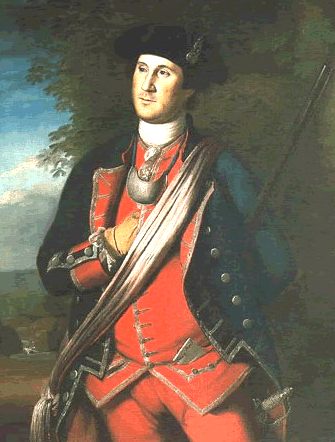
As part of their military strategy, a large British Army reinforced by militiamen from four colonies, which included Lieutenant Colonel George Washington of Virginia, moved to drive their rivals, the French and the Indians, out of the hotly contested Ohio Territory.  On the hot afternoon of July 9, 1755, near the site of what is today Pittsburgh, Pennsylvania, however, a joint force of French and Indians ambushed the advancing British-colonial army, and a desperate battle ensued.  Caught in the middle of the vicious attack, the youthful Washington moved to the front of the action in an attempt to help direct the fighting.  Suddenly, an Indian warrior appeared out of the dense smoke, aimed at the mounted figure silhouetted by the afternoon sun, and fired his musket directly at the future first President.  The musket ball ripped through the red and blue coat the Virginian was wearing, missing his heart by a mere hair’s length.  So caught up in the battle was Washington though that he failed to even realize that he had just literally slipped from the grasp of death.

More and more Indians began to take notice of the large man in the red and blue coat, and they too pointed their guns at him.  Another bullet tore open his hat, just missing his skull, and again he did not even notice it.  A third shot hit his horse a moment later and killed it.  Young George jumped to his feet as the animal collapsed to the ground.  He immediately ran over and climbed on another horse a few feet away, but that horse too was killed only seconds later even as two more bullets ripped open his coat.  He struggled off the dying horse and raced for a third horse as he shouted encouragement to his fellow soldiers.  He had only been on his third horse for a matter of minutes before that horse too sank to the ground from a bullet. 

Chaos continued to erupt all around Washington, and more shots punctured his hat and coat until there was almost nothing left of either.  Through all of this, not a single musket ball actually touched his body.  As the battle raged around him, Washington heard a loud echo near him.  He instinctively looked to the nearby British commander, only to see the general fatally shot in the back.  With their commander down, the panicked and disheartened British soldiers began to retreat in confusion.  As one of the few officers not killed or wounded, George Washington took command of the troops and rallied the remnants of the army in an organized withdrawal back to Philadelphia, Pennsylvania, the future birthplace of the United States.  The story of his bravery under fire and his miraculous escape from death followed him and soon spread throughout the thirteen colonies, making him a national hero to many.

When he discovered in the aftermath of the battle that his body was untouched but his hat and coat had been ripped apart by the multiple shots taken at him by the Indians, young George Washington began to realize that a higher power was directing his footsteps.  He later attributed his survival in the Pennsylvania wilderness to the will of God, or the mercy of “Divine Providence” as he called it.  It would only be the first of many times where he realized that there might be a greater purpose for his life.  That grand purpose would become clear nearly twenty years later when he was asked to command the Continental Army in the struggle for independence.  Even in his acceptance of command, the man who came to be called “the father of his country,” spoke of God’s divine protection and how he prayed for God to give him success.  Had God not spared his life in western Pennsylvania, it is very possible that the future United States of America would not only have lost a good and capable man to lead the struggle for American independence, but the country would also have lost a man who served as a reminder that there is purpose in every life.             

6 Comments

Filed under Uncategorized