Category Archives: Uncategorized

“As Stubborn as a Mule”

images-1

There is a saying that a person can be “as stubborn as a mule.” It refers to an obstinate person, one who refuses to be moved. Although stubbornness is often thought of as a vice, there are certainly times when it can actually be a virtue. In one of the early battles of the Civil War, there was a Union officer who occupied a critical position and refused to allow the Confederates to drive him from it. He and his soldiers held their position against repeated Confederate attacks. His name was Stephen A. Hurlbut. This is the story of how he steadfastly, even stubbornly, defended the Peach Orchard at the 1862 Battle of Shiloh.

Stephen Augustus Hurlbut demonstrated early on a desire to chart his own course in life without conforming to the expectations of others. Though he was a native of Charleston, South Carolina, born in late 1815, his parents were not Southern aristocrats but rather Northerners with staunchly nationalist views. He became a lawyer and, mirroring his parents’ nationalist perspective, formed a close friendship with James L. Petigru, one of Charleston’s leading unionists and the chief opponent of states’ rights spokesman John C. Calhoun. He joined the Whig Party, a forerunner of the Republican Party, rather the Democratic Party like most South Carolinians. He left South Carolina in 1845 and resettled in Illinois where he continued to serve in the Whig Party until 1856 when he joined the new Republican Party. He campaigned hard for Abraham Lincoln’s election as president in November 1860, then watched as his native South Carolina seceded in December. Believing war between the North and South was imminent, Hurlbut determined to leave politics for the army.

Stephen Hurlbut’s service in the Civil War showed him to be stubbornly committed to crushing the “rebellion,” as Northerners called it. A trusted colleague of Lincoln’s, he first tried to avert war by serving as the President’s envoy to Charleston, but his efforts ended fruitlessly when the Confederates fired on Fort Sumter on April 12, 1861. Hurlbut immediately joined the Union army, and in June President Lincoln appointed him a brigadier general over volunteers from Illinois and Iowa. In command of a brigade, he marched south into Missouri to protect the Hannibal & St. Joseph Railroad against Confederate guerrillas. Hurlbut denounced the guerrillas as traitors and arrested those suspected of being Confederate sympathizers. Despite pursuing the guerrillas across northeast Missouri, he was never quite able to corner and destroy them. In early 1862, he left Missouri to join the new Army of the Tennessee as commander of the army’s Fourth Division. As part of Ulysses S. Grant’s command, he marched his division towards the Confederate rail hub of Corinth, Mississippi. In early April he camped at Pittsburg Landing on the Tennessee River twenty miles north of Corinth in the vicinity of a small wooden church known as Shiloh. There, in a matter of days, Steven Hurlbut would help save the Union army from total destruction.

By the evening of April 5, 1862, Brigadier General Stephen Hurlbut began receiving reports of significant movements just to his front. The day before, April 4th, he had heard the sounds of battle coming from the woods near his headquarters on the extreme left flank of the Union army. He had ordered his troops to fall into formation and to advance forward. As he moved towards the sound of battle, however, General William Tecumseh Sherman informed him that it was only a cavalry skirmish, and he needed to return to camp immediately. Hurlbut reluctantly obeyed the order, but it was a mistake that the Union army soon paid for. Just before dawn on April 6th, Confederate General Albert Sidney Johnston, probably the South’s finest battlefield commander at the time, unleashed his forty-four thousand men against the forty thousand Union troops who were just waking up and preparing breakfast. The Confederates achieved such surprise that most Union soldiers simply ran for their lives and did not even attempt to put up a fight. Not all Union forces did so however. The troops commanded by Hurlbut refused to retreat, and the general himself led by example. He mounted his horse and began issuing orders to his brigade commanders. He even sent one of his brigades to help General Sherman’s forces and then personally led the remainder of the division into the Peach Orchard to bolster the position held by Brigadier General Benjamin Prentiss. Once Hurlbut had reached the edge of the Peach Orchard, he refused to be moved by the enemy.

As the Confederates pushed through the Peach Orchard, Hurlbut formed a new defensive line along the edge of it to repulse the Confederate attack. General Prentiss linked up with Hurlbut and extended the Union line along a sunken wagon road, soon to earn the name “the Hornets’ Nest,” so called because of the non-stop “buzz” of rifle and musket fire. Both men’s attention was fixed on the sight of Confederate forces marching towards them. Sitting tall in the saddle in a resplendent uniform, Hurlbut ordered his artillery to fire on the advancing Confederates. Then he began to ride down the line of infantry to encourage his troops. He was so focused on his task he barely noticed an artillery round that exploded only ten feet from him or a rifle shot that struck a tree beside his head. Concerned for his safety, a staff officer told him to get down, but Hurlbut replied that “we generals must take our chances with the boys.” Suddenly, he saw Texas troops approaching. He ordered his soldiers to wait until the Texans were only three hundred yards away and then deliver a withering barrage of musketry. His troops followed his orders, and nearly two hundred Texans fell dead or wounded. Another of his regiments attacked a large body of Confederates and drove them back. Attack after attack came on. His spirited defense provided protection to the east flank of the Union army, but he could see that Confederate forces were close to overrunning his position.

At 2:30 in the afternoon, General Hurlbut watched as Confederate General Albert Sidney Johnston gathered his forces for a final assault that would attempt to drive Hurlbut’s division from the Peach Orchard. As Johnston readied his men for the attack, he told those around him that “General Hurlbut seems to be mighty stubborn” and that Confederate forces would have to use the bayonet to drive them out. Hurlbut was indeed stubborn, but even stubbornness could not prevent overwhelming Confederate forces from breaking his lines. With no other alternative, Hurlbut ordered a tactical retreat. As he and his soldiers withdrew towards Pittsburg Landing, however, one of his soldiers turned and fired a shot that hit General Johnston in the femoral artery. The Confederate general bled to death in minutes, extinguishing one of the South’s brightest stars. Meanwhile, Hurlbut and his division reached Pittsburg Landing where they formed up along a wooded ridge. There they remained as the Confederates launched several more assaults before halting for the night. Hurlbut used the lull to strengthen his position. As dawn broke on April 7th, Grant came up to Hurlbut and ordered him to take up his position on the flank as the Union troops launched a counterattack. He and his division then went on the offensive to drive the Confederates back to Corinth. During the fighting, Hurlbut had a bullet graze his arm and had a horse shot from under him. Once the Confederates withdrew, his troops returned to their camps. General Hurlbut had performed with distinction at Shiloh. His obstinate refusal to surrender the Union flank without a fight may well have saved the day. General Grant understood this when he personally praised him for his key role in preventing the Union army’s annihilation.

Following his efforts at Shiloh, Stephen Hurlbut continued to fiercely engage the Confederate forces. He participated in the campaign to capture Corinth, Mississippi, and in October 1862, he fearlessly led his division into battle against the Confederates in the Battle of the Big Hatchie River. In reward for his service, he was promoted to major general and given command of the new Sixteenth Corps. He and his corps were stationed in Memphis, Tennessee until early 1864, at which time he was placed in command of the Army of the Gulf in New Orleans, Louisiana. In both cities, he followed orders to crack down on cotton smugglers. He arrested inhabitants and seized their property. His actions alienated many residents, and he was accused of drunkenness and war profiteering. Despite the charges, his superiors, especially General Grant and Secretary of War Edwin Stanton, refused to take any disciplinary action against him. They chose instead to muster him out of the Army in June 1865 at the end of the war. He returned home to Illinois to pursue politics once again.

As he settled into postwar life, Hurlbut continued to serve his country in a variety of roles. In 1866 he gained election to the Illinois House of Representatives where he supported the construction of a new statehouse. A few years later in 1873, he won election to the U.S. House of Representatives where he became involved in civil service reform. He also served his country outside the U.S. as a diplomat. First he served President Grant as U.S. Minister to Colombia. While there he attempted to negotiate a treaty that would allow the U.S. to develop a canal across the Isthmus of Panama. He served President James Garfield much the same way as the ambassador to Peru, helping to negotiate an end to the war which Peru was waging with Chile. It was in Lima that he died on March 27, 1881 of a massive heart attack. He dutifully served the Union in whatever task he was assigned, always with the tenacious character for which he was known.

Stephen Hurlbut’s life serves as a good example of taking a personal trait that is oftentimes considered a negative and turning it into a positive. Most consider stubbornness to be a desire to remain entrenched in one’s position or attitude, refusing to consider any alternative. On April 6, 1862 at the Battle of Shiloh, Stephen Hurlbut proved otherwise. He showed that a refusal to be moved is sometimes what it actually takes to win. Without his determination to hold his position no matter what, the Confederate army might have destroyed Grant’s army and turned the tide of the war in the West. Instead, Hurlbut held his division together and forced the enemy to devote precious time and resources in overpowering the threat facing them. Hurlbut and his men may have been driven back temporarily, but in actuality, it was his stand that helped precipitate the Union’s ultimate victory in that key battle. Stephen Hurlbut dug in his heels and refused to be moved — “as stubborn as a mule.”
1 Comment

Filed under Uncategorized

Peace Through Strength

images-1

There are times when, as incongruous as it may seem, peace can only be achieved through war. No matter how hard the diplomats may work, some groups will only submit to peace initiatives when their very existence is threatened. In the last years of the eighteenth century, an American officer waged a military campaign on America’s western frontier to bring peace to the region. He took military action in order to establish stability between American settlers and the native residents. His name was Anthony Wayne. This is the story of how he drew his sword to win peace for the Northwest Territory.

By the early 1790’s, Anthony Wayne had become one of the fiercest warriors in the American army. Born on New Year’s Day, 1745 in Easttown, Pennsylvania, Wayne was an ardent patriot who steadfastly served America during the Revolution. As a brigadier general in the Continental Army, he earned a reputation as a stern disciplinarian and as a ferocious warrior. In fact, his men affectionately called him “Mad” Anthony for the zeal he showed in battle. He fought with distinction at the battles of Brandywine and Germantown, Pennsylvania in 1777, at Monmouth, New Jersey in 1778, at Stony Point, New York in 1779 and at Green Spring Farm, Virginia in 1781. He was even present at the surrender of British General Lord Cornwallis at Yorktown before being ordered to Georgia to combat the last remnants of the British presence in the South. It was in Georgia that Anthony Wayne had his first taste of battle with the Indians that had long menaced America’s western borders.

As the Revolution came to an end, Anthony Wayne was forced to confront the Native Americans who had fought alongside the British. Early on he came face to face with the guerilla tactics of Indian warriors. The Indians had allied with the British in hopes of halting American migration westward. On the morning of June 24, 1782 Wayne and his soldiers were encamped along the Ogechee River in Georgia when they were attacked by a band of Creek Indians. Wayne quickly organized his troops and launched a counterattack that successfully drove the Indians into the nearby countryside. He saw the Indians as a menace and denounced British officers for encouraging attacks. The Revolution soon came to an end, but he continued to monitor Indian movements in Georgia for a time. He briefly campaigned for the position of Commissioner of Indians in Georgia, and after the adoption of the U.S. Constitution, he petitioned the new American government to create a Southwest Territory to protect Georgia’s frontier from future Indian attacks. He wanted to serve as the territory’s governor-general with the ability to oversee civil and military affairs, but instead he was given an even more important assignment. He was given command of the American army in the Northwest Territory with orders to subdue the Indian threat there.

In early March 1792 Anthony Wayne received his commission as a major general from President George Washington and was charged with leading the American army against the Indian nations in the distant regions to the west of Pennsylvania and to the northwest of the Ohio River, a vast area known as the Northwest Territory. Backed by their British allies in Canada, a coalition of Indian tribes, including the Shawnee, the Miami and the Lenape, had launched raids on American settlements in the territory. President Washington and Secretary of War Henry Knox had already sent peace commissioners to negotiate a truce with the Indians, but they recognized that an army was required to protect frontier inhabitants. A fighter was needed to command that army, so they settled on one of the best fighting generals of the Revolution. Wayne enthusiastically accepted the command, but he was told the army would only act once diplomacy had failed. The idea was anathema to Wayne, but he agreed to wait.

In the meantime, he travelled to Pittsburgh to join the Legion of the United States, as the army in the Northwest Territory was called. He spent the next seven months training the soldiers and monitoring the negotiations. He considered them fruitless since the Indians seemed to violate the newly negotiated cease-fire by continuing their raids, even attacking American soldiers who carried flags of truce. He urged Secretary of War Knox to authorize him to make preparations for the Legion to strike the enemy immediately. Instead, Knox told Wayne that most Americans desired to see a diplomatic solution to the situation and that American military action could potentially arouse the sympathy of the British. Negotiations continued, but Wayne simultaneously began to plan a military campaign to advance the Legion into the Northwest Territory in late 1793. He was eager for war to erupt so he could finally remove the threat Indians posed to the safety of the American frontier.

In the late summer of 1793 Wayne received word that peace negotiations had finally broken down and he was to march his Legion to Fort Washington, just outside the town of Cincinnati, Ohio and then into the Northwest Territory. Arriving in Cincinnati, he learned that his total force numbered just over two thousand men. The majority were soldiers from the United States Army, but there was also a detachment of Kentucky militiamen. The army was ready to advance, on October 7, 1793, with Wayne at the head of his column, the troops moved northward into enemy territory. He told his officers to keep a close watch on their soldiers since he expected to engage the Indians in battle at any moment. Except for a few brief sightings of Indian raiding parties, however, the Legion saw little action. It was not long before winter conditions set in, and Wayne had his troops build Fort Greeneville to guard the region and to serve as a winter camp for the army. As 1793 came to an end, Wayne was certain that the next year he would finally face the Indians in the climactic battle for the Northwest Territory.

As 1794 began, Anthony Wayne prepared to launch an assault against his Indian foes. He had originally intended to pressure the Indians enough to avoid a pitched battle, but Indian leaders made it clear they intended to fight the Americans. The Americans proved equally determined to defeat the Indians. When a group of Indians attacked Fort Recovery, one of the forts Wayne had built during his advance, the Americans inside the fort inflicted heavy losses on the Indians and forced them to withdraw. In the wake of this victory, Wayne and his army advanced against the main body of Indians encamped along the Maumee River not far from Lake Erie. Then on the morning of August 20, 1794, at what came to be known as the Battle of Fallen Timbers, the vanguard of the American army encountered a large Indian army and immediately engaged in battle. Hearing the roar of muskets, Wayne raced to the front and surveyed the sight before him. The Indians had taken cover in a grove of upturned trees and dense underbrush. From their position, they fired on Wayne’s soldiers as they prepared to attack the army’s left flank. Despite suffering from the pain of gout, Wayne took decisive action in countering the Indians. He ordered his infantry to charge the Indian center while his cavalry was ordered to charge the Indians from the flanks and rear. His officers obeyed his command and led their troops forward. The Indians were so stunned by the Americans’ audacity that they quickly fell back. At the Battle of Fallen Timbers, Wayne delivered a crushing blow to the Indians of the Northwest Territory, but he remained convinced he had to destroy the enemy’s will completely and force them to sue for peace.

In the aftermath of his decisive victory, Anthony Wayne sought to consolidate American control of the Northwest Territory. He set upon a course that would result in the total defeat of the Indian nations in the region. He ordered his soldiers to destroy Indian crops and villages as they advanced against tribes like the Miami. He also had his soldiers build additional forts to guard against future Indian attacks, like the one named Fort Wayne in his honor. The Indians, now confronted with overwhelming force, never again attacked Wayne’s army. As winter of 1794 approached, Wayne returned to his base at Fort Greeneville where he met with Indian leaders who now understood the necessity of reaching a peaceful accord with the Americans. He assured them that his government wanted to achieve a lasting peace with all the Indian nations of the region, and they agreed to return in six months. He composed a preliminary peace treaty for the chiefs to take with them and sent a copy of the treaty to President Washington and Secretary Knox in Philadelphia. He received instructions from them with orders to tell the Indians that a series of military forts would be built to protect the frontier inhabitants and prevent any possible Indian attack. In mid-June 1795 he welcomed the chiefs back to the fort and opened up the negotiations. In early August Wayne and the chiefs signed the agreement ending hostilities and turning over much of Ohio and Indiana to the United States. The use of force and the threat of annihilation had finally ended the conflict between America and the Indian tribes of the Northwest Territory.

Anthony Wayne remained an American hero for the rest of his life. He had brought peace to America’s western frontier, and his triumphs were celebrated when he returned to Philadelphia for the first time in three years. He spent the rest of 1795 and the start of 1796 in the American capital before returning to the Northwest Territory in May. Upon his return, he supervised the American occupation of Detroit and other northwestern towns held by the British, as dictated by the terms of the Jay Treaty between the U.S. and Britain. Wayne established his new headquarters at Detroit and helped institute new civilian governments for those towns under American jurisdiction. As he oversaw his new responsibilities, he experienced a recurrence of the gout that he had suffered from at Fallen Timbers. He left Detroit for a Pittsburgh but only made it as far as the garrison located on Presque Isle on Lake Erie, now Erie, Pennsylvania. He arrived severely weakened, and soon the gout spread to his stomach. He died on the morning of December 15, 1796 at age fifty-one. Though later reinterred in his hometown of Easttown, he was originally buried at the garrison of Presque Isle in the Northwest Territory, in the heart of the region where he had brought peace.

Anthony Wayne’s service in the Northwest Territory showed that there are times when the best way of obtaining peace is through the force of arms. A country stands a better chance of avoiding all out war if it is willing to back up its words with action. Diplomacy should always be given full reign, but oftentimes diplomacy itself is simply not enough. When diplomatic relations fail, the judicious use of military power is sometimes the only means to the desired end. “Mad” Anthony Wayne, one of America’s finest battlefield generals, fully understood and appreciated the policy our country still abides by today — peace through strength.

1 Comment

Filed under Uncategorized

An Undersea Transformer

images-1

There have always been individuals of vision who can see potential in technological innovation. They realize that all it takes is a new way of thinking, the right approach and hard work to transform the new innovation into a valuable tool in its particular field. During the early twentieth century, there was an American naval officer assigned to an emerging branch of the U.S. Navy. He dedicated himself to one of those new technological innovations, and he soon harnessed its power. With his drive and foresight, this new branch became an effective arm of the U.S. Navy. The officer’s name was Chester W. Nimitz. This is the story of how he helped shape submarines into one of the Navy’s best offensive weapons.

Like the submarines he later commanded, Chester William Nimitz seemed an unlikely choice for the important role he would play in naval warfare. He was born an only child in late February 1885 to a recently widowed mother in the small German community of Fredericksburg, Texas, located in the hill country not far from the state capital of Austin. His early years were spent in and around his grandfather’s “Steamboat Hotel” before he moved to nearby Kerrville with his mother and new stepfather. To help support his family, he worked at a local hotel and as a delivery boy for the local meat market. He believed he would never advance any further, but after meeting a couple of West Point cadets, he decided to enter the United States Military Academy. His Congressman told him he would be unlikely to enter West Point, but there was an opening at the Naval Academy in Annapolis. Despite never finishing high school, Nimitz was tutored well enough to pass the entrance exams and enter the Academy. Over the next four years, he often awakened before reveille even sounded so he could study an extra hour before classes began. He was well-liked by his classmates and developed a friendship with a football player named William F. “Bull” Halsey. In addition to his classes, he excelled in tennis and rowing. He graduated seventh in the class of 1905 and soon after was commissioned a Navy ensign. His first years in the Navy awakened him to the fact that naval officers needed to accept new innovations if they wished to create a truly global naval power.

At the time Nimitz began his naval career, the great bulk of America’s naval power rested with surface warships. Most of the new ships were battleships or cruisers. In fact, the first ship Nimitz served on was on the new battleship Ohio as it sailed from America to Japan on a highly sensitive diplomatic mission. His time at the Naval Academy had taught Nimitz that entrenched commanders judged surface warships to be the true masters of the waves, and to them — the bigger the better. Senior officers saw this view validated in America’s victory in the Spanish-American War and in Japan’s recent victory over Russia when battleships had engaged each other in in decisive sea battles. Even as America built newer surface ships however, others began to fall into disrepair. After serving on the Ohio, Nimitz served on several older ships such as the Decatur, which was so worn out that nothing on it functioned properly. He was eventually recalled to the U.S. with orders assigning him to submarines. It would be this duty that would launch Nimitz on the road to success.

Despite the fact that most naval officers looked down on submariners, Nimitz dutifully accepted his new posting without complaint. He had first sailed on a submarine as a cadet, but he had hardly been impressed with its capability. That view had not changed in the intervening years. He once called them “a cross between a Jules Verne fantasy and a humpbacked whale.” Nevertheless, he took command of the Plunger, the Navy’s second commissioned submarine, and he quickly concluded the submarine fleet needed a massive overhaul. The first issue he confronted was the type of engines used to power submarines. In the early days, gas engines powered submarines, but gasoline fumes fouled the air in the confined space and the volatile fuel even caused explosions at times. Seeing the danger with such engines, Nimitz immediately urged a switch to diesel engines instead. Over the next few years, nearly one-third of American subs became diesel powered. Subs that operated on diesel now had a greater range and could be adapted from defensive weapons to offensive weapons. This change in capability led submarine designers to build subs with additional torpedo tubes. Previously, most subs only had one tube. Nimitz led the way in transforming the submarine fleet, commanding such subs as the Narwhal, the Shipjack and the Sturgeon, all of which incorporated these modifications to the original design. It was not, however, only physical changes to submarines that Nimitz desired. His time on board subs further convinced him that one day such vessels might even be able to escort a fleet of surface ships far out into the ocean. As America headed towards war, it became apparent that submarines were destined to become a vital tool in the American arsenal.

Nimitz had become one of America’s leading experts on submarines by the time America entered World War I. In 1912 he had addressed the Naval War College in Newport, Rhode Island on the feasibility of using submarines for offensive purposes. Over the next five years, he was offered the chance to leave the Navy and join the private industry where his knowledge of diesel engines was highly valued. Instead he stayed in the Navy. After war erupted in 1914, he watched as Germany unleashed the might of its own submarine force against Allied merchant ships. This unrestricted warfare resulted in America entering the war in April 1917. American destroyers and subs were ordered out on seek-and-destroy missions. In August he too left for Europe to join the commander of the submarine force’s Atlantic fleet as an engineering aide. While U.S. submarine forces had little strategic impact in World War I, this assignment allowed him to observe the tactics and engineering capabilities of British and German submarines as they engaged each other in battle. In addition to lessons learned in submarine warfare, the experience moved Nimitz from the engineering and operational side of the Navy into the ranks of the command structure. After World War I ended, Nimitz returned home determined to build up the U.S. submarine fleet in anticipation of the next military conflict.

Chester Nimitz continued to be an advocate of undersea warfare even as he served in other positions. By the time he returned from Europe, the upper echelons of the Navy brass had begun to come around to the immense potential of submarines. New models, which would allow submarines to range far beyond America’s coastline, were being developed and launched on a regular basis. As part of this national buildup, Nimitz served as adviser to the Chief of Naval Operations on how best to design new submarines. Before long he received orders to report to Pearl Harbor, Hawaii to develop a Pacific submarine fleet and base. The fleet and base were soon completed, and Nimitz assumed command of the new sub base. He enjoyed the posting and even developed a close relationship with many of his subordinates. He later served in a similar capacity as the commander of the submarine fleet stationed in San Diego. During this posting, he befriended an officer he came to know well in the coming years, Raymond Spruance. When his tour at San Diego ended, he served as assistant chief of the Naval Bureau of Navigation and later as the bureau’s chief. He was in that position on the morning of December 7, 1941 when he received word that the Japanese had attacked his former base at Pearl Harbor.

In the immediate aftermath of the Japanese attack, Chester Nimitz was ordered to return to Pearl Harbor. He would not just be commanding the submarines though. This time he had orders to command the entire U.S. Pacific Fleet “till the war is won,” as President Franklin D. Roosevelt put it. Fittingly, Nimitz officially announced his presence as the new commander from the deck of a submarine in the debris-filled harbor. After touring his command, he realized that the submarine fleet was one of the few groups of ships to escape destruction. Understanding the need for America to strike back, he ordered the subs out to attack the Japanese. Over time, the rest of the American Navy was rebuilt and went on the offensive as well. Nimitz directed America’s response from his command base in Hawaii and later in Guam. He proudly watched the resurrected fleet push the Japanese across the vast expanse of the Pacific Ocean to the waters surrounding the island nation. Two of his most valued commanders were his old friends “Bull” Halsey and Raymond Spruance, now four-star Admirals. He himself eventually rose to the rank of Fleet Admiral, a five-star rank, in December 1944. Despite often contesting the right strategy with General Douglas MacArthur, Nimitz became a national hero and was on hand to accept the surrender of Japanese forces on September 2, 1945.

With the war over, Nimitz continued working to bolster the capabilities of the Navy. He returned to the U.S. to serve as Chief of Naval Operations where he cooperated with the Air Force in developing nuclear weapons. His work eventually reaped huge rewards when submarines and other ships began to carry nuclear weapons. He eventually retired to California but did not retire from public service. He served as a regent for the University of California at Berkeley and wrote articulate articles and books supporting the need for a powerful Navy. He represented President Eisenhower at the funeral of his old friend, Admiral Halsey, and he even briefly served in a United Nations position before returning to Berkeley where his health faded over the next few years. He died in 1966 and was buried in Golden Gate National Cemetery in San Francisco, which overlooks the ocean he sailed on. Throughout his career, he had proudly worn the dolphin insignia of a submariner.

Chester W. Nimitz spent much of his professional life trying to effectively develop and utilize a new component of the United States Navy. He saw the benefits the country would reap if it aggressively pursued this innovative weapon system. Through his persistence and hard work, submarines became one of the most effective and lethal weapons in the U.S. arsenal. Today, they help to project American influence and power throughout the world. One of the prime movers of this major transformation in U.S. naval warfare has, for the most part, only been known as the commander of the Pacific Fleet in World War II. Long before he ascended to that lofty position however, Chester Nimitz proved that he was one of those rare individuals with the vision, courage and drive to challenge the conventional way of doing things and to embrace a new and innovative way of thinking.

1 Comment

Filed under Uncategorized

What So Proudly He Hailed

images

From the very founding of the nation, the American flag has carried a message of hope and triumph, even during the country’s darkest days. In both good times and bad, the flag has continued to wave. During the War of 1812, there was a young American lawyer who bore witness to one of the country’s most critical battles to remain a free country. He had watched American cities come under direct attack and even be destroyed. American soldiers still fought valiantly under the American flag, and in the aftermath of a crucial American victory, this young patriot composed an anthem for all time. His name was Francis Scott Key. This is the story of how the American defense of Fort McHenry inspired him to write “The Star-Spangled Banner.”

Francis Scott Key served his nation at one of the most critical times in its history. He was born in 1779 to a Continental Army officer who served under George Washington and even met the president when he toured the region in 1791. He grew up on his family’s plantation in northern Maryland, but he left home at age ten to attend grammar school in Annapolis. He later studied law at St. John’s College and established a law practice in the city. He soon developed a close friendship with another young lawyer named Roger B. Taney, who later served as Chief Justice of the Supreme Court and wrote the notorious 1857 Dred Scott decision. In 1806, Key moved from Annapolis to Georgetown, in the District of Columbia, and quickly became one of the city’s most promising attorneys, even appearing before Chief Justice John Marshall and the Supreme Court. His home in Georgetown became a haven for those critical of President James Madison and the approaching war with Britain. Key believed that disaster would befall America if war erupted. Nevertheless, he watched as his country went to war in June of 1812. Little did he know it, but he would be affected by the war more than he could possibly imagine.

America’s military fortunes seemed to seesaw back and forth in the first two years of the conflict, but by the late summer of 1814, it appeared as if Key’s prediction of catastrophe was about to be realized. A British fleet had appeared off of Maryland’s coast in July and British soldiers had begun to march on the national capital. Despite his opposition to the war, Key determined that he would fight to repel the invaders from American soil. He joined the local militia as a civilian aide and watched as the American army tried to stop the British invasion at Bladensburg, Maryland. The Americans were defeated however and were forced to withdraw. Key returned to Georgetown while the British occupied Washington, D.C. From his home, he watched as the British set fire to the Capitol and the President’s House. The British left two days later with the intention of taking the strategic port of Baltimore, Maryland. Though Key had witnessed the fall of Washington, he would soon have a front row seat at the deliverance of Baltimore.

Francis Scott Key’s observance of the climactic battle for Baltimore came about almost by accident. As the British withdrew from Washington, they imprisoned Dr. William Beanes for his role in the capture of several British soldiers. Key was chosen to lead an effort to gain the doctor’s release. He travelled to Baltimore where he boarded a packet ship and sailed down the Patapsco River into the Chesapeake Bay. After two days of searching, the ship intercepted the British fleet as it approached Baltimore. Key boarded the flagship Tonnant and met with British Admiral Sir George Cockburn and General Robert Ross, the men responsible for the destruction of Washington. After arguing the case for Beanes’ release, Key was told that the doctor would be released, but neither of them could return to Baltimore until after the British attack. Over the next three days, Key watched the British finalize preparations for their attack and was appalled at the destruction the British had planned for the city. One officer even told Key the British would almost certainly burn and plunder Baltimore the same way they had Washington. As the sun set on September 12, 1814, Francis Scott Key prepared to watch the climactic Battle of Fort McHenry.

The American Fort McHenry stood on a peninsula guarding the Baltimore waterfront. As day began to break on September 13, 1814, Key watched seventeen British ships, including five bomb ships and one rocket ship, move into position nearly two miles from the fort and prepare to bombard the fort’s garrison. He knew that British officers, including Admiral Cockburn, were confident of success due to the fact that the bomb ships’ mortars were capable of firing shells weighing nearly two hundred pounds. At 6:30 a.m. the British opened fire and the Americans, commanded by Major George Armistead, immediately returned fire on the British ships. Key watched the unfolding drama, but after a time, he grew concerned when the firing from the fort began to diminish. Seeing the American flag continuing to wave, however, he realized that the garrison had not conceded defeat by lowering the flag, the universally recognized symbol of surrender. In actuality, Major Armistead had simply ordered his men to cease firing due to the great distance between the fort and the ships. The majority of the garrison took cover in the fort’s dry moat while American gunners occasionally opened fire just to show they were still there. As the afternoon progressed, American soldiers found themselves pelted not only by a hailstorm of British shells but also by a literal rainstorm. The fort experienced numerous direct hits. One shell even hit the powder magazine but failed to explode, and several Americans were killed and injured. As the daylight drew to a close, it appeared as if the bombardment would continue to rain death and destruction as the British determined to remain on station throughout the night.

At the “twilight’s last gleaming,” Francis Scott Key saw that the American flag still waved proudly over the walls of Fort McHenry, but the battle was not over yet. The British fleet unleashed all their might on the fort as the night of September 13th turned into the early morning of September 14th. The citizens of Baltimore crowded the rooftops of buildings and watched the fight with desperate anticipation. Out in the harbor, Key similarly stood on the deck of the packet boat straining to see the explosions from the shells and the rockets being launched from the ships around him. He could no longer see the flag in the darkness, but the bombardment assured him that the fort still remained in American hands. He spent many hours pacing the deck and looking in the fort’s direction for any indication of what was happening. It was an unnerving experience for him. Finally the enemy fire lessened in intensity, and quiet settled over the harbor.

As Key adjusted to the quiet, clouds and a pre-dawn mist hung low in the sky obscuring the fort from view. He frequently pulled out his watch as he breathlessly awaited the first hints of dawn. Then the moment came. Key turned his eyes on the distant fort. He saw a flag atop the flagpole, but he could not see if it was “the stars and stripes, or the flag of the enemy” that was flying above the fort. The flag hung limp for several moments, but then a breeze swept over the harbor. Suddenly, as if God himself wanted everyone to know, a beam of light hit the flag. It was the Stars and Stripes! Key was overcome with emotion at the sight. He would later write that he hoped “I shall never cease to feel the warmest gratitude when I think of this most merciful deliverance.” He immediately took out pen and paper to write a song befitting “such defenders of their country.” It truly was a momentous event for the young country and the pivotal moment in the life of Francis Scott Key.

In the days following the battle, Key shared his elation for the American victory with the entire country. Two days after the battle, September 16th, he, Dr. Beanes and the crew of the packet boat were released as the British fleet sailed away from Baltimore. The residents of Baltimore enthusiastically greeted Key and his companions when they arrived in port later that night. He took a room at a local tavern and spent the night finishing his new song. Setting the words to a popular tune called “To Anacreon in Heaven,” Key showed the work to friends who decided it had to be published. On September 20th, the song appeared in the Baltimore American and Commercial Daily Advertiser newspaper under the title “Defence of Fort M’Henry.” Then on October 19, 1814, it was publicly performed at Baltimore’s Holliday Street Theatre as “The Star-Spangled Banner.” The song’s popularity spread not only through Baltimore and Maryland but to other cities on the East Coast as well. Many Americans hailed it as an American masterpiece. One newspaper even said it would “proudly rank among the best efforts of our national muse.” Key was similarly praised for his talent in composing the song after it was revealed he was the author. His name would forever be linked with the valiant defense of Baltimore and, indeed, the nation.

For the rest of his life, Francis Scott Key continued to serve his country. Not long after America’s “providential” victory, as he called it, he returned to his home in Georgetown and to his law practice. He gained a reputation as one of Washington’s most prominent attorneys, even being appointed by President Andrew Jackson as U.S. Attorney for the District of Columbia. He enthusiastically supported Jackson and served as legal adviser to the president. Despite each of these accomplishments, however, Key remained a national hero for penning “The Star-Spangled Banner.” He was continually praised for its composition and was even greeted with it when he made visits to American cities. He finally retired from public life in 1841 and lived quietly for the next two years. In early January 1843 he returned to Baltimore for business, but he soon developed a severe cold and lapsed into delirium. On January 11, 1843, only a few miles from the fort he helped make famous, Francis Scott Key died at age sixty-three. In his honor, flags were lowered to half-mast in Washington and Baltimore. The United States Congress later resolved that the American flag, the real star-spangled banner, would forever fly over Key’s grave. More significantly, on March 3, 1931 Key’s inspiring song was designated the national anthem.

Francis Scott Key’s life was forever defined by the words he wrote that September day in 1814. Just hours before he had thought it likely America faced a future as black as the night sky above him. Now, “by the dawn’s early light,” it was clear that to him that America had a bright future ahead of it as long as there were brave citizens willing to defend it, like the ones inside Fort McHenry. Hearing and singing the song, each of us should remember and honor the sacrifice required for the American flag to fly over a free people. We should keep this lesson in mind particularly this week as we celebrate the two hundredth anniversary of the Battle of Fort McHenry. Let us strive to ensure that the star-spangled banner continues to wave “o’er the land of the free and the home of the brave.”

1 Comment

Filed under Uncategorized

“Rise and Fight Again”

images

Even though a person may appear to be “down and out” during a struggle, it is precisely at that moment when he or she should rise up and fight back. The determination to continue the fight demonstrates an inner strength and character that oftentimes ultimately leads to victory. In the early part of the American Revolution there was an American officer who, much like his commander, George Washington, refused to give up easily. He often personally led attacks against the British. One of these attacks came in the aftermath of one of America’s worst humiliations, yet the officer saw the battle as an important achievement in the long struggle for independence. He was Major General Nathanael Greene. This is the story of his participation in the daring attack aimed at the very heart of the British army at Germantown, Pennsylvania.

Nathanael Greene rose to national prominence while overcoming a number of obstacles in his path. He was born in August 1742 in Warwick, Rhode Island into a prominent family of Quaker foundry men. Despite being the third son, it was he that his father expected to manage the family’s enterprises like the iron forge used to make anchors. Working at the forge, Greene grew into a robust young man, but he frequently suffered from asthma attacks as well as from a limp in his right leg. His father’s unyielding beliefs prevented Nathanael from receiving a proper education, so he largely educated himself using works like Euclid and John Locke. He also read books dealing with the art of warfare. His interest in military affairs eventually forced him to leave the Quakers, who held fast to pacifist beliefs. As protests against Britain intensified, he joined the local militia as a private after initially being denied an officer’s commission due to his limp. He trained with the militia until word of Lexington and Concord reached him in April 1775. At that point he was appointed to the rank of major general in the Rhode Island militia and charged with leading the Rhode Island Army of Observation to Boston. In the coming years, he would repeatedly prove his fighting ability, even when the odds were stacked against him.

During the first two years of the American Revolution, Nathanael Greene gained George Washington’s trust with his aggressive, fearless leadership. After arriving in Boston, Greene engaged his troops in consistent training. Washington appreciated such professionalism and soon elevated Greene to brigadier general and then to major general in the Continental Army. Although Greene’s troops performed poorly in the battles around New York City, as shown by the loss of Fort Washington on Manhattan and Fort Lee in New Jersey, he personally led the attack that captured Trenton, New Jersey in December 1776. Then in January 1777, he again demonstrated conspicuous valor when he risked his life to rally withdrawing militiamen at Princeton, New Jersey. Nine months later, on September 11, 1777, it was he who led the rearguard action that allowed the American army to withdraw safely from Brandywine Creek. He then watched as the British captured the American capital of Philadelphia on September 26, 1777. Like George Washington, Greene wanted a chance to strike back at the British and to demonstrate that the American fighting spirit remained unyielding.

Nathanael Greene and the American army had retreated to a position nearly fifteen miles from the small village of Germantown, which was located only five miles from British-occupied Philadelphia. Due to the crisis, reinforcements from New York, New Jersey and Maryland had poured into camp and swelled the ranks of the American army to eleven thousand strong. On October 2, 1777, the Americans captured several British dispatches that revealed British General William Howe only had nine thousand soldiers in Germantown. It was clear that the Americans outnumbered the British, and if there was going to be an attack, it had to happen immediately. Greene and the other senior commanders all agreed that the time to attack had come. It would be a surprise, just like the attack on Trenton. The proposed attack would occur at dawn on the morning of October 4, 1777. Greene’s division, nearly five thousand strong, was the largest force in the attack and would be placed on the left end of the army. Greene had agreed that an attack was necessary to remind the British of the Americans’ resolve, but before he could do that, he and his men first had to fight their way through the Pennsylvania forest to the battlefield.

At 7 p.m. on the evening of October 3, 1777, Greene began the march, plagued with problems from the start. Many of the soldiers did not have shoes or any covering for their feet. In addition, Greene had to cover almost seventeen miles instead of the fifteen discussed by the officers. The entire journey had to be made in the dark over back roads so the British would not detect their approach. Greene had hired a local guide to direct his men, but the guide became disoriented and lost the way. After stumbling around for a time, the guide finally discovered the correct path and led Greene in the direction of Germantown. Instead of becoming discouraged, as some would have, Greene maintained his composure and quickened his advance towards the village, eventually making up a half hour of marching. Greene and his troops reached the outskirts of Germantown as the sun rose in the sky and as the noise of battle swept across the field.

As Green and his troops advanced toward the fighting, they were able to make out the musket and cannon shots coming from the vanguard of the American army’s assault. Greene later learned that the British had been taken by complete surprise and quickly withdrew from their camps as the Americans pursued them. Suddenly, a dense fog settled over the combatants, and the smoke from musket rounds lessened visibility even more. Greene caught the tail end of this pursuit as he deployed his men for battle. It appeared as if the American attack would be a success, just as Greene and the other commanders had hoped. Greene was so eager to join the fight that he barely noticed when a musket ball clipped a lock of hair off his head. The division surged forward, but some of Greene’s troops became disoriented in the fog and mistakenly fired on their fellow Americans. At the same time, other American units were bogged down firing on British troops who had taken up position in in a brick house. The British took advantage of the Americans’ distraction to regroup and launch a counterattack that slowly pushed the Americans out of Germantown. Greene and others reformed the soldiers before withdrawing twenty miles from the scene of the battle. Despite the defeat and the loss of eleven hundred men, Greene and the majority of the army saw the engagement at Germantown as a badly needed moral victory. They recognized that they had carried the battle to the enemy and had even succeeded in briefly driving the British soldiers out of their camps. Every officer and soldier in the army could take justifiable pride in that. Many officers and soldiers, including Greene, even saw the defeat as the result of bad luck rather than a problem with tactics. The high morale indicated that Greene and the American army were becoming a more professional lot.

Nathanael Greene understood what the fight at Germantown meant to the fighting spirit of the American army, and it gave him the determination to see the Revolution through to the end. Not long after Germantown, Greene was named the quartermaster general and set to work purchasing supplies for the army at Valley Forge. He served as quartermaster general for the next three years, even while serving as a battlefield commander in his native Rhode Island and in New Jersey. In late 1780, he was appointed by Washington to be the new commander of the Southern Department. For the next two years, he led the American army across North and South Carolina and Georgia in an effort to wear down his British pursuers. He periodically engaged them in fierce fights in the backcountry, such as at Guilford Courthouse in North Carolina. Of these fights, he famously said that the Americans would “fight, get beat, rise and fight again.” Although some of the battles were military defeats, they were strategically successful in eventually forcing the British to leave the backcountry, which bottled them up at their main base in Charleston, South Carolina. Finally, on December 14, 1782, the British boarded their ships and allowed Greene and his troops to proudly march into the city. When the war officially ended in 1783, Greene was one of only three general officers who had served continually throughout all eight years of it — George Washington and the American army’s artillery commander Henry Knox were the other two.

Sadly, Nathanael Greene did not live long after the American Revolution ended, but he remained a hero to the American public, especially in the South. He often travelled back and forth between Rhode Island and his plantations in the states of South Carolina and Georgia. On these trips, he observed how his family business in Rhode Island and other pieces of real estate he owned had been laid waste by the years of war. He eventually settled down on his Georgia plantation, called Mulberry Grove. He found himself deeply in debt and would spend the rest of life fighting to repay those debts. In mid-June 1786, Greene travelled to Savannah, Georgia for a meeting with one of his creditors. As he returned home to Mulberry Grove, he experienced a severe headache, which soon turned into a swelling of the forehead and a loss of consciousness. He died on June 19, 1786 at age forty-three with his old comrade, General “Mad” Anthony Wayne, at his bedside. He was buried in an unmarked vault in Savannah, Georgia, only to be recovered and reinterred in a public ceremony in 1901.

Nathanael Greene was one of those individuals who possessed a fierce desire to come back from whatever defeat he had been dealt. He did not allow himself or those around him to stay down long. He fought through personal and professional obstacles throughout his life. In the long and trying struggle for independence, he understood that it was important for the American soldiers to pick themselves up and continue to engage the enemy even when things looked bleak. He urged them to “rise and fight again.” Greene’s support for military action at Germantown, Pennsylvania showed that he never allowed himself or his men to believe they were out of the fight for good. His “never say die” attitude was the key to victory for the fledgling country that took on the mighty British Empire.

2 Comments

Filed under Uncategorized

Saved By Grace

rowlandson1

When tragedy befalls a person, friends and family are likely to ask why that tragedy had to happen. There is no easy answer to that question, but I believe there is one possible rationale. I believe that God may allow bad things to happen in order to teach people that He is in control of every situation, both good and bad, and they need to rely on Him alone for strength. During the seventeenth century, there was an American colonist who found herself in one of the most difficult circumstances any colonist could face. Having nowhere else to turn, she threw herself on the graciousness of God and sought comfort in the Holy Scriptures. God rewarded her trust in Him and brought her through the ordeal. She later wrote a book praising Him for his goodness to her. Her name was Mary Rowlandson. This is the story of how God gave her the strength to survive her captivity by Native Americans.

Mary Rowlandson’s early life experiences helped shape her into a woman who was able to survive the worst that life could throw at her. She was born Mary White in Somerset, England around 1637, though the precise date remains unknown. Little is known of her early life except that she and her family immigrated to the Massachusetts Bay Colony while she was still fairly young. Life in those early colonial days was anything but safe, easy or comfortable. The family initially settled in Salem before moving to the frontier town of Lancaster, where Mary’s father established himself as the wealthiest man in town. In 1656 she married Joseph Rowlandson, a graduate of Harvard and Lancaster’s new Puritan minister. The couple had four children together, but their firstborn, a daughter named Mary, died as an infant. Except for these few facts, the next two decades of Mary’s life remain obscure. She performed household chores like sewing, cooking, and gardening and raised her three surviving children. She also looked out for the perils that accompanied frontier life. It would not be long before one of the greatest perils, an Indian raid, afflicted Mary and the other inhabitants of Lancaster. The settlers’ faith and fortitude, particularly that of Mary, would soon be tested beyond all comprehension.

In early 1675 fifty years of peace between the colonists and the Indians came to an end as the colonists pushed deeper into Indian territory. Chief Metacomet of the Wampanoag, or King Philip as the whites called him, united the local tribes and led them in a series of attacks on frontier towns in a bloody conflict that came to be infamously known as King Philip’s War. Mary’s husband traveled to Boston to petition for a military presence in Lancaster, but at dawn on February 10, 1675, while he was away, the Indians attacked. Entering the town, they burned homes and killed several villagers. They soon targeted the two-story Rowlandson home where many villagers had sought safety. The Indians took cover and fired their muskets so rapidly that, in Mary’s words, “the bullets seemed to fly like hail.” Three of the home’s defenders were killed in a two-hour firefight before the Indians set fire to the house. Mary ran out of the house with her children, only to have a bullet hit her in the side and then hit her six-year-old daughter Sarah in the abdomen. At the same time, she watched the Indians kill her sister, brother-in-law and nephew. In total, thirteen inhabitants of Lancaster were, in Mary’s own words, “butchered by those merciless heathens.” Twenty-four others, including Mary and her children, were taken captive. As the Indians carried Mary away, she clung desperately to the only thing that could then sustain her — her faith in God.

As Mary and the other prisoners were dragged west along the Connecticut River, she pleaded with God to show her favor. Being a devout Puritan, she believed that He was the only one able to give her the strength to survive. She began to view the beatings and the mocking, as well as her separation from her two oldest children, as God’s punishment for her wicked ways. Then she had to endure the death of her six-year-old daughter Sarah from the wounds received in the raid. Mary’s own wounds healed and she remained relatively healthy as she consumed Indian rations, but she still needed God’s spiritual and emotional healing. In desperation, she called out to God for help, and in her words, He “renewed my spirit” with the knowledge that He was right there beside her during her suffering. He also showed her grace when He compelled an Indian to provide her with a Bible taken in one of the raids. Mary kept the Bible with her as she was moved from camp to camp, at one point even meeting King Philip himself. As she travelled, she read the Bible and meditated on the promises that God revealed to her.

As weeks turned into months, Mary Rowlandson searched the pages of her Bible to ease her anguish. She read of the sufferings of Job and began to see the parallels with her own losses, including the death of her young daughter and the destruction of her home. Like Job, she refused to abandon her faith or blame God for her troubles. Instead, she drew hope from the verse in Jeremiah that promised an ultimate reward for one’s struggles and the verse in Psalms that commanded her to remember that God was firmly in control. The verses reassured her that she would not be overwhelmed by her circumstances. Rather, she blessed the Lord for “His goodness in bringing to my hand so many comfortable and suitable scriptures in my distress.” She treasured the stories that told of King David and other heroes of the faith who underwent experiences similar to her own. She fully comprehended that Isaiah and Psalms were correct when they described how God’s ways and thoughts are far superior to those of humans. God used her captivity to remind her that He was in supreme control and He had the ability to sustain her, even in the middle of so desperate a plight. God’s plan did include a happy ending for Mary though. She was finally released in May 1675 after three months of brutal captivity.    

As word of her horrific experiences and miraculous survival spread throughout New England, Mary Rowlandson became widely known. After reuniting with her husband and her two surviving children, she briefly settled in Boston. When asked about her captivity, she credited God with sustaining her and protecting her, just as He had protected Daniel in the lion’s den. The family soon moved to Wethersfield, Connecticut where Mary’s husband served as the local minister. He died in 1678, three days after preaching a sermon in which he discussed his wife’s captivity. Mary married Captain Samuel Talcott a year later, and in 1682, she published an autobiography entitled The Sovereignty and Goodness of God, describing her experiences as a captive. Some scholars have described it as one of the first American bestsellers. She gained recognition for her work, but except for a few brief court testimonies in 1707, little else is known about her later life. Mary Rowlandson died in 1710 or 1711.

Mary Rowlandson’s life reminds us that tragedies do happen in life. The issue is how we deal with them. For Mary, she survived the ordeal, physically and psychologically, by trusting that God had supreme authority over her life. Through her darkest hour she clung to the belief that God would never leave her nor forsake her. With that belief she gained comfort, strength and hope. Without it, she would have succumbed to despair and loss. Mary Rowlandson could not control any part of her time in captivity, but God could and did. She simply had to “let go and let God.” From this colonial woman’s incredible story of faith and survival perhaps we too can learn to triumph over adversity.

3 Comments

Filed under Uncategorized

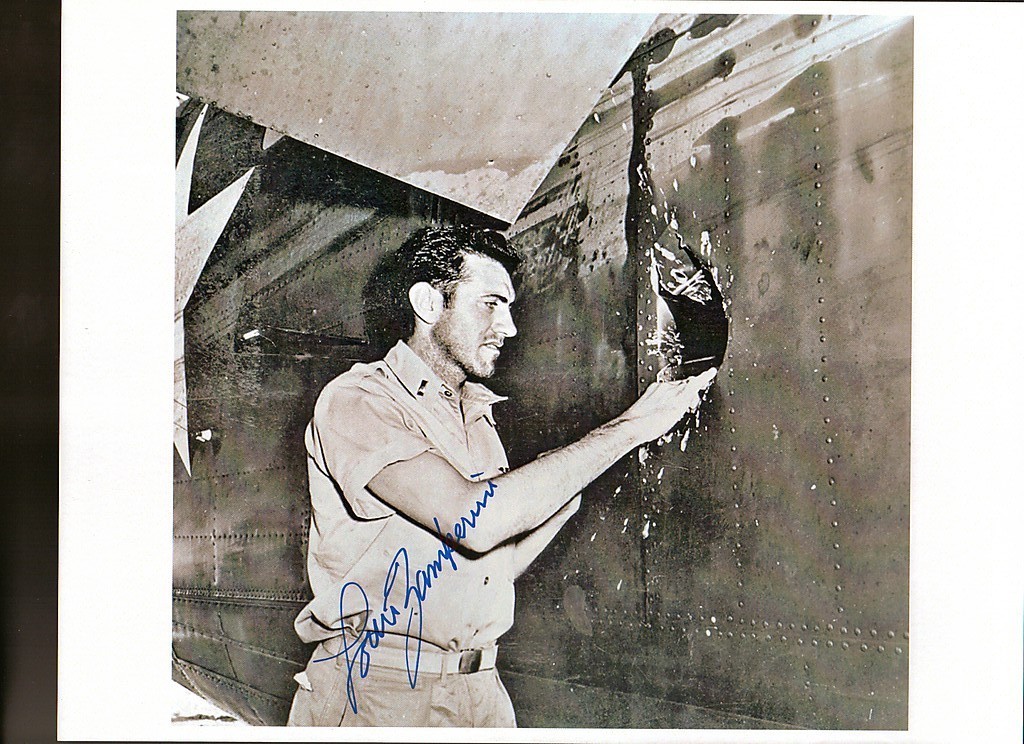
A Real “Survivor”

louis_zamperini_body

Trials and tribulations plague everyone, but every once in a while someone comes along whose story of survival is so extraordinary that it merits special attention. There was a young American airman in World War II who endured almost unimaginable terrors during a protracted life or death battle, the winning of which would only lead to further ordeals. It would take all of his strength just to make it through each day, but his struggles and eventual victory not only made him legendary but also enabled him to inspire others. His name was Louis Zamperini. This is the story of his forty-seven day fight to survive the dangers of the Pacific Ocean.

From the beginning, Louis Silvie “Louie” Zamperini had to fight his way up to overcome challenges. Born to Italian immigrants in January 1917 in New York, he moved to Torrance, California with his parents and three siblings at the age of two. He made a series of bad choices during his adolescence, and it was not long before he was engaged in petty theft and appeared on the edge of ruin, a full-blown juvenile delinquent. His older brother Pete persuaded him to become active in track in an effort to stop his downward spiral, and stop it he did. Called the “Torrance Tornado,” Louie set his high school’s track record, the state record and the national high school record in the 1934 Southern California Track and Field Championship in the mile run before switching to the five thousand meters race. He became the youngest distance runner to ever make the U.S. Olympic Team. At the 1936 Berlin Olympics, he failed to medal in the event but caught the attention of everyone, including Adolf Hitler who met Louie after the race, by finishing the final lap of the five thousand meter race in only fifty-six seconds. He was poised to make history, but history had other plans for him.

Louis believed he had a bright future in track, but the outbreak of World War II started him on a new path in life. He had returned home to California to attend USC with his sights set on becoming the first person to run the mile in under four minutes. As war clouds gathered on the horizon however, Louie was forced to abandon his dreams, and in late 1941 he joined the Army Air Corps as a bombardier. He learned how to operate the Norden bombsight, a computer that used air speed and altitude among other variables to calculate the optimal moment for unleashing bombs. Upon the completion of his training, he was commissioned a second lieutenant and assigned to the crew of a B-24 Liberator in the Seventh Air Force. After saying good-bye to his family, he travelled first to Washington State to join the crew of the Super Man, as the bomber was named, and then to Hawaii. Little did Louie know that he was about to endure the first of several great trials in his life.  

Louie’s time in the Pacific would be one of the most turbulent periods he ever endured. Arriving in late 1942, Louie almost immediately saw action against such Japanese-controlled islands as Wake and Tarawa. He also experienced the effects of combat on aircraft and airmen. His own aircraft was shot up so badly on one mission that the uninjured crewmembers had to abandon it. It was poor timing because on the morning of May 27, 1943 the crew was ordered to board a substitute aircraft, Green Hornet, and participate in a rescue operation. A few hours into the search, one crewmember noticed there was a disproportionate amount of fuel in each of the tanks. As the pilot attempted to equalize the tanks, engine failure occurred. Louie raced to the rear of the airplane to assume a crash position. Moments later the B-24 hit the water.   Louie was entangled in the plane’s wires before he was finally able to break free and swim to the surface. He was in the middle of the vast Pacific.

Louie Zamperini had survived the crash, but now he realized he had to survive the dangers of being lost at sea. Only the pilot and the tail gunner had survived along with him. Seeing two life rafts nearby, Louie climbed aboard one and helped the other two aboard the other one. Taking charge of the small party, Louis found the raft held only a few chocolate bars and a few half-pint tins of water. There was no other food or drinks to be found. Louie told his comrades they could only have a bite of chocolate in the morning and a bite in the evening, and they could only drink two or three sips of water every day. As the raft began drifting west from the crash site, sharks began to swim around the three men, close enough for the men to reach out and touch. Louie tried to sleep that night, only to awake the next morning and discover that the tail gunner had eaten all of the chocolate. Now there was no food at all, and the temperature was rising fast. The next few days passed slowly as the men did their best to survive. The sighting of a B-24 on the third day briefly gave them hope, but Louie’s efforts to gain their attention met with failure. Each of the men knew they had to be rescued soon as the next day saw them finish the small amount of water they had. With no food and no water, the three survivors’ health quickly declined. Days of drifting turned into weeks.

As the weeks passed, the rafts continued to float west, and Louie and his companions waged a battle for their physical and mental survival. Each day they sat in the scorching sun stung by salt and wind coming off the ocean. They used a rainstorm to obtain drinking water and cleverly caught several birds and fish to alleviate their hunger. Louie engaged his companions in a series of questions and stories, including tales of meals his mother had prepared, to keep their minds sharp.   He grasped the necessity of keeping their spirits high in spite of their dismal predicament. By the end of the twenty-eighth day, the men had lost much weight and had unkempt beards. All three, especially Louie, offered daily prayers for their deliverance. At one point, he even promised God he would serve him his entire life if they were rescued. They could not have known that by that time they had drifted into Japanese territory. They were about to experience human contact for the first time in weeks, though that contact would result in dangerous encounters for the men.

As the four-week mark approached, Louie and his two companions were almost at the end of their tether when they finally glimpsed an approaching plane. Knowing it might not work, they decided to try and signal it using a flare gun. The pilots spotted them and, to the men’s horror, strafed the helpless airmen. The plane was Japanese. With no choice, Louie threw himself into the ocean while the other two huddled in the raft. Bullets tore through the raft and into the water. Fortunately for Louie, the bullets’ impact was lessened below the surface, but as he looked down, he saw sharks coming straight for him.   He kicked and punched at them until they swam away leaving him unharmed. He climbed back up on the raft to rejoin his comrades only to find one of the rafts destroyed. The three men huddled together on the remaining raft and attempted to patch the raft and refill it with air. As if that were not hard enough, they had to fend off sharks as they were doing it. At times sharks literally jumped up on the raft, which forced the men to use what little strength they had left to push them off. Louie decided there was a more practical way to deal with them. He killed one of the small sharks, and the three ate the liver, the only part humans can consume. It did little to help them though, as by the thirty-third day the tail gunner was dead and the other two were mere skin and bones. Finally, on day forty-six, Louie and his surviving companion saw a group of islands directly in front of them. They had drifted almost two thousand miles to the Marshall Islands. Now they were prisoners of the Japanese.

Unfortunately, Louie’s struggles were not over yet. He found himself transferred from camp to camp. At one, the Japanese found out exactly who he was, and despite his weakened condition, they forced him to race against several Japanese runners. The Japanese also sought to use him for propaganda purposes, but he refused to cooperate. In late 1944, he arrived at Omori POW camp in Tokyo Bay. He was greeted by Corporal Mutsuhiro Watanabe, who was known to the POW’s as “the Bird” and who would make it his personal mission to break Louie’s spirit. Louie became the Bird’s “number one prisoner” singled out almost daily for brutal beatings and humiliation. Louie’s defiance only infuriated the Bird more and resulted in even more savage beatings. At one point, the Bird forced other prisoners to punch Louie after several thefts had occurred. The Bird also forced him to hold a wooden beam up as punishment for visiting the doctor without permission. Louie’s patience with the Bird had run out, and along with others, he considered killing his tormenter. The dropping of atomic bombs on Hiroshima and Nagasaki prevented him from committing such an act. Days later, Louie and the others received word that the war was finally over.

The fighting may have ended, but Louie soon discovered the scars of war took longer to heal. With victory achieved, Louie returned home in October 1945. Reporters quickly besieged him, and he sought relief in alcohol. His drinking intensified his natural aggression, and he began picking fights. His marriage to Cynthia Applewhite suffered as a result, and she finally decided to divorce Louie. She changed her mind though after hearing Billy Graham speak and encouraged Louie to hear him. He finally gave in and heard Graham describe situations similar to what he had endured. He surrendered his life to Christ and honored his promise made to God on that tiny lifeboat in the Pacific. He became a Christian speaker telling his story to audiences, founded the Victory Boys Camp to reform ruffians like him, and traveled to Japan to forgive his former captors. Louis Zamperini died on July 2, 2014 at age ninety-seven, having survived all that life could throw at him.

Louie Zamperini’s life stands as a testament to the fight to survive that is instilled within us. He certainly went through more life or death struggles than most. He often lingered on the very point of death only to somehow pull himself back from the brink. The ordeal he overcame while adrift only led to further torment. He suffered unspeakable cruelty at the hands of his fellow man, and he not only endured but eventually found the inner strength, by the grace of God, to forgive those who had tortured him. His later life was dedicated to helping others through their life challenges. Louie Zamperini was not just a survivor of incredible trials and tribulations but a survivor of the highest order — one who used his personal experiences to inspire others to do the same.  

2 Comments

Filed under Uncategorized

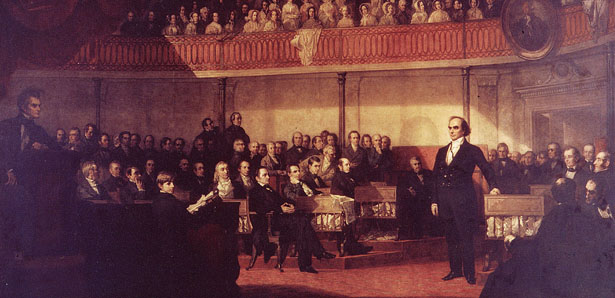
One Nation, Indivisible

6-Websters-reply-to-Hayne-1830

Political differences have always existed in America, but for Americans today those disagreements seldom occur solely along geographic lines. This has not always been the case though. In the early nineteenth century, political concerns were oftentimes based on purely sectional interests. Most notably, the North and the South found themselves clashing over conflicting economic interests. In the early 1830’s, however, there was one American politician who attempted to remind all Americans that geographical boundaries should not dictate the political concerns of the nation. One of his greatest moments came when he delivered a speech proclaiming the importance of national unity. His name was Daniel Webster. This is the story of how he waged a political battle to protect the nation from those whose private interests would threaten the very existence of a unified country.

During his life, Daniel Webster saw the differing sectional interests evolve into a full-blown national crisis. He was born in 1782 in New Hampshire to a father who fought in the Revolution, served in New Hampshire’s Constitutional Ratification Convention, and loyally supported George Washington. The older Webster raised his son with the same appreciation for the new country. After attending Exeter Academy, Daniel entered Dartmouth College where he studied law. Later he moved to Boston, Massachusetts, establishing himself as a successful lawyer before being elected to the U.S. House of Representatives in 1822 and the Senate in 1827. At the same time, he showed that he already had a national perspective on matters. He had stood apart from other New Englanders who called for possible secession due to their opposition to the War of 1812. As an elected representative, he worked to serve Massachusetts’ interests, but he also appeared before the Supreme Court on a number of occasions to argue the supremacy of national laws. He became convinced that sectional concerns needed to take second place to national interests. It would not be long before Webster employed this argument in one of the greatest speeches in American history, defending the belief that America truly was one nation and not just a collection of regions with competing interests.

Daniel Webster’s cherished dream of national cohesion was threatened in 1828 when the Southern states contested the constitutionality of a federally mandated revenue collection. The national legislature had passed a new protective tariff — a tax collected on goods brought into the country — in order to protect the mercantile and textile industries emerging in Northern cities. Webster recognized that the tariff was designed to benefit large parts of the country. Unfortunately, the tariff negatively affected certain trade and financial interests in the South. In response, Southerners decried the Tariff of 1828 to be a “Tariff of Abominations.” Many in the South hoped the newly elected president from Tennessee, Andrew Jackson, would work to weaken its effect. To their disappointment, Jackson refused to oblige them, and Southern leaders searched for an alternative to negate the tariff’s restrictions. The alternative ultimately seized upon by Southerners would propel Daniel Webster into the limelight as the primary spokesman for national cohesion.

Daniel Webster may have been a Northerner who worked for the good of his constituents, but more importantly, he was a staunch defender of the Constitution. He held firm to the belief that the national government had supreme authority over the states. He also believed that the Constitution banded all of the states together as one. Contrary to this position, however, many Southerners, most especially Vice-President John C. Calhoun, maintained an abiding belief that loyalty to an individual’s state trumped one’s loyalty to the entire country. Southern opposition to the “Tariff of Abominations” demonstrated Southern determination to protect their sectional interests, even at the expense of national unity. Soon after passage of the tariff, Calhoun and his fellow Southerners called for a radical new step. They revived an argument originally made by Thomas Jefferson and James Madison that a state had the power to declare null and void any law that the state felt violated the Constitution. Hearing this argument, Webster recognized the danger of the national government giving in to such a threat. If states could decide which laws to obey then the very future of the Union was in doubt. Webster was not the only one alarmed by this turn of events. Nullification thoroughly enraged President Jackson. While Jackson would ultimately take steps that forced the “nullifiers” to back down, it was Daniel Webster who stood as the country’s defender at this moment of crisis.

In January 1830, Daniel Webster saw the time had come to prove his dedication to the Union. On January 19, he called on Senator Robert Hayne of South Carolina to engage him in a debate on the theory of nullification. Over the next few days, Hayne defended an individual state’s right to defy federal legislation if it adversely affected the state. He justified such an argument by claiming that the states had voluntarily joined together to create the Constitution. By this interpretation, the states had retained the power to determine, on a case-by-case basis, whether or not a federal law was beneficial to the individual interests of the state. If the law was not beneficial, Hayne argued, it was the state’s prerogative to declare that it would not abide by the law. Hayne’s arguments drew support from many Southerners who held firmly to the conviction that the ultimate power in federal legislation remained with the states. The argument was not persuasive to those senators who shared Webster’s more nationalistic view. Once Hayne had concluded, Webster readied himself to give a speech that would ring out as a clarion call for the protection of the Union.

On January 27, 1830, Daniel Webster delivered a stirring response to Hayne’s defense of nullification. In countering Hayne’s claims regarding state supremacy, Webster maintained that it was the individual citizens of the country who had created the nation, and the states had no authority to decide if the law violated the Constitution. He argued such a decision only rested in the hands of the justices who composed the Supreme Court. He then went as far as to claim that if a state attempted to subvert power given to the people of America, the state was committing an act that bordered on treason. He spoke of how it was the national union that gave America the strength and reputation it enjoyed and how America’s standing in the world would suffer if the national union failed. As he closed, Webster expressed a desire that the country not shatter because of sectional divisions. From his deathbed, he said, he did not want to see the sun “shining on the broken and dishonored fragments of a once glorious Union.” Rather, he desired to “behold the gorgeous ensign of the republic” proudly floating across a united country. That “gorgeous ensign” he thundered stood for “Liberty and Union, now and forever, one and inseparable!” His declaration was greeted with cheers from supporters of the Union in every state, and they began to label Webster as the “Defender of the Constitution.” It would be a title he would carry for the rest of his life.

In the immediate aftermath of his “Liberty and Union” speech, Daniel Webster continued to stand as one of the foremost defenders of American unity. He was most outspoken in 1832 when South Carolina carried through with its threat and nullified the tariff. Webster immediately called this act “another name for civil war” and predicted that if the government failed to respond then “from that moment the whole Union is virtually dissolved.” He vocally supported President Jackson’s promise to use military force to subdue the “nullifiers,” as they were called. The use of force proved unnecessary as Calhoun and others managed to reach a compromise solution. Even though the immediate threat to the country had been removed, Webster saw the dark clouds ahead and continued to urge national cohesion.

Throughout the rest of his life, Daniel Webster personally reached out to those on the opposite side of the political fence in order to achieve the harmonious accord of which he had previously spoken. In the aftermath of the nullification crisis, the North and the South engaged in debates over slavery. Webster attempted to alleviate the South’s fear of abolition by claiming that the national government had no authority over slavery where it currently existed. As the debates continued though, Webster saw the threat of an approaching storm. In an effort to preserve national solidarity, Webster worked with states’-rights supporters, first as President John Tyler’s Secretary of State in the early 1840’s and later backing his old opponent John C. Calhoun to craft the Compromise of 1850. He would be denounced by abolitionists for accepting the Fugitive Slave Act, which required the return of runaway slaves to their masters, but he saw the Compromise as a necessary evil if the country was to escape a bloody civil war. His efforts ultimately failed, but he would not live to see it. Daniel Webster died on October 24, 1852, nine years before the civil war he had predicted finally came to pass.

Daniel Webster was a warrior to the end, but his battlefields were the halls of Congress and the court of public opinion where he fought to preserve the country he loved. Webster may have been born in the North, but his ultimate loyalty was not to his native Massachusetts. His was a more modern view of the country — one where you were an American first and a Southerner, Northerner, Texan or New Yorker second. He himself said in the debates over the Compromise of 1850 that he did not speak “as a Massachusetts man, nor as a Northern man but as an American.” In every sense the “Defender of the Constitution,” he stood defiant in the face of those who attacked the solidarity of the nation. He understood the power of “oneness” and the idea of the whole being greater than the sum of the parts. Daniel Webster worked tirelessly his whole life to hold together this dream called America. May his words stand for all time — “Liberty and Union, now and forever, one and inseparable.”

1 Comment

Filed under Uncategorized

A Forgotten Emancipation

177

Americans today are firmly of the opinion that “all men are created equal…with certain inalienable rights.” The Declaration of Independence asserts three rights that are endowed by the Creator — life, liberty and the pursuit of happiness — but perhaps the most important to the Founding Fathers was the right to liberty. Our early leaders were united in their desire for Americans to live their lives free of domination by others. Some of them, particularly George Washington and Thomas Jefferson, also recognized the inconsistency of fighting against oppression while withholding the blessings of freedom from their African-American slaves. Not all American slave owners could live with this inconsistency however. Near the end of the eighteenth century, there was one member of the founding generation who stood apart in his desire to give freedom to his slaves immediately rather than wait for his death. His name was Robert Carter III. This is the extraordinary story of how his humanity towards his slaves climaxed with his decision to emancipate them.

Robert Carter III was a member of one of Virginia’s most prominent families. Born in 1728, he was the grandson of Robert “King” Carter I, founder of a family dynasty that lasted for generations, and the son of Robert Carter II, whose plantation of Nomony was not far from the birthplace of George Washington and the family home of the Lees of Virginia. The deaths of his father and grandfather when he was only four-years-old left him financially secure with sixty-five thousand acres of land and nearly one hundred slaves. Over time, he increased his land holdings and the number of slaves to nearly four hundred and fifty, making him the largest and wealthiest slave owner in Virginia. Like many of his contemporaries, he participated in Virginia politics. Unlike others, he failed to gain entry into Virginia’s House of Burgesses, but he did receive an appointment to the Governor’s Council. As a member of Virginia’s colonial government, he associated with George Washington and Thomas Jefferson. He differed from these future Revolutionary heroes not only in his legislative service but also in his attitudes towards the slaves he owned.

Known as “the most humane to his slaves of any in these parts,” Robert Carter attempted to deal more justly and compassionately with his slaves than many of his neighbors did. Like his grandfather Robert Carter I, Robert Carter III often refused to split up slave families, especially mothers and children. In addition, Carter refused to act arbitrarily in the sale of his slaves. He believed in following the example of his friend, Virginia’s royal governor Francis Fauquier, and soliciting slaves’ advice as to who their new master should be. Most of the time, the slaves requested sale to plantations in close proximity to dispersed family members. His consideration of slaves’ requests demonstrated his understanding that his slaves had needs and desires that were common to all men and women. More amazing than the way Carter handled the management of his slaves was the amount of freedom he gave them to conduct their own lives.

As master of the plantation, Robert Carter attempted to provide his laborers with greater opportunities than many slaves enjoyed on other plantations. Unlike most slave owners, Carter allowed his slaves to choose their own names and the names of their children rather than doing it himself. He also refused to personally dictate the amount of work and the speed with which it took the slaves to complete each task. More often than not, he was more likely to criticize his white laborers than he was his black ones. Instead, he gave important responsibilities, such as managing his mill, to his slaves. His confidence in them became so great that he allowed them to serve as his personal representatives in legal matters. This high regard for black laborers extended to his willingness to accept the word of his slaves over another’s. He once favored a black slave’s account of a horse’s death over the word of a white employee. It became clear that slaves at Nomony enjoyed more freedom than they did on other plantations, and the slaves returned Carter’s trust. As plantation master, he hardly ever had to punish his slaves or deal with a possible slave rebellion. Rather than simply chaining up a slave, as he had occasion to witness, Carter preferred to offer his slaves “due process” in the form of a trial for their crimes. Some of these beliefs were already radical prior to the American Revolution, but the Revolution transformed Carter both politically and spiritually.

As the American Revolution progressed, Robert Carter’s views on liberty and slavery came to coalesce as one. In the first months of the Revolution, Carter hoped for reconciliation between the colonies and Great Britain, but after reading Thomas Paine’s Common Sense, he came to believe in independence and a republican government. He made the observation that America, like the Jews of old, should have no king but “the Lord of Hosts.” His belief in the liberty held by all people stretched to include his slaves. Though some left to join the British army, the vast majority of slaves remained with Carter. His acceptance of the Revolution’s egalitarian principles seemed to be enhanced by his spiritual awakening.

Carter’s political revelation regarding human liberty was fulfilled by his acceptance that faith was possible for everyone as well. The impetus for this spiritual enlightenment was his inoculation against smallpox. During the procedure, he experienced a “most gracious Illumination,” in which he claimed to see God. The experience convinced him to leave the Anglican Church and join the dissenting sect known as the Baptists. His attendance in the new denomination brought him into contact with many of those outside of conventional society, especially slaves. By worshipping and taking communion with common laborers, Carter gained a greater appreciation for them. He openly referred to his slaves in letters by either their given names or by the title of “brother.” As a fellow believer, he took greater interest in slaves’ lack of economic security. To provide a better livelihood, Carter offered his slaves the use of farms previously owned by white tenants. By the end of the Revolution, Robert Carter had begun to see the incompatibility of slavery in a free country.

In the aftermath of the American Revolution, Robert Carter continued to grow apart from his fellow Virginia slave owners. Throughout the Revolution, he had not only diversified his crop production to include wheat, but he had also begun to invest in industrial ventures. His participation in these activities allowed him to lessen his own dependence on the institution. As he strived to accomplish his goal, he watched a new government form under the Constitution. He was deeply distressed that the new government protected slavery. While he could not do anything on the national scene, he could at least do something about his own situation. By 1791, Robert Carter had set to work writing an extraordinary document — the Deed of Gift.

On September 5, 1791, Robert Carter submitted his Deed of Gift to the district court in Northumberland County, Virginia. In it he affirmed his intention of freeing all four hundred and fifty-two slaves, an act that seemed to finish what Thomas Jefferson began in the Declaration of Independence when he declared it self-evident “that all men are created equal, that they are endowed by their Creator with certain inalienable rights.” In his personal “emancipation proclamation,” Carter wrote how he believed keeping African-Americans in slavery was “contrary to the true principles of religion and justice.” Despite protests from those around him, Carter remained steadfast and began the lengthy process throughout 1792 and 1793. He then permitted the ex-slaves to settle on his land as tenants and work as freed men and women. As the process continued, Carter left his plantation at Nomony behind and settled in Baltimore, Maryland. In his last years, he was left with almost nothing — not his land, not his wealth and not even the acclaim rightly due him for his noble deed. He died on March 10, 1804 and was buried in an unmarked grave, soon to be all but forgotten along with his act of emancipation.

Robert Carter III was one of the few men who truly understood that the American Revolution’s promise of liberty was meant for everyone. With a single signature, Robert Carter III privately freed more slaves than anyone else in the country. Unfortunately, many Americans only remember Abraham Lincoln as the “Great Emancipator.” Robert Carter’s act of selfless generosity, however, does not deserve to be ignored as if it never happened. Despite being obscured by Washington and Jefferson, he should proudly stand beside them as an equal. It was he who most conspicuously acted on the belief that the “inalienable right” of liberty belonged as much to his African-American workers as it did to him. All who cherish the dream of liberty should remember Robert Carter III and the first emancipation.

1 Comment

Filed under Uncategorized

Lifted Above Limitations

fdr95

One of the most difficult challenges that a person can face is to rise above his or her limitations. We all face them, but one of the most daunting limitations is a lack of physical mobility that can keep a person from enjoying the full spectrum of life in the very physical world in which we live. In the early twentieth century, there was a New York politician who suffered such a loss of mobility. The loss seemed to end his political ambitions, but it actually marked the start of an amazing comeback. This politician failed to just accept his condition. He began a struggle that would eventually enable him to claim the greatest prize sought by any American politician. He is remembered today as one of America’s greatest presidents. He was Franklin Delano Roosevelt. This is the story of his personal battle to overcome polio and how he forged the determined spirit that would prove so vital in steering the country through some of its darkest moments.

From his earliest days, Franklin Roosevelt seemed to have all the advantages in life that were necessary to achieve whatever he wanted. Born to a well-to-do family in January 1882, he was a distant cousin of Theodore Roosevelt. In his youth, he travelled with his parents not only to Europe and several foreign capitols but more importantly, as it turned out, to Washington, D.C. where he even met President Grover Cleveland. He and his parents also spent most summers on the Canadian island of Campobello, off the coast of Maine. At fourteen he entered the elite preparatory school of Groton before attending Harvard University, where he was editor-in-chief of the university newspaper. In March 1905, he married his distant cousin and Theodore’s niece, Eleanor Roosevelt. Five years later he entered politics as a New York state senator. In 1912, President Woodrow Wilson appointed him Assistant Secretary of the Navy. In that position, he orchestrated naval operations during World War I and even visited the frontlines in France. After the war, he joined Ohio Governor James Cox as the vice presidential candidate during the 1920 election. To that point, his rise was meteoric. Unlike his cousin Theodore, however, Franklin lost his bid, and it was not long before he suffered another blow that seemed to end his political career altogether.

On July 28, 1921, Franklin Roosevelt journeyed up the Hudson River to join a group of Boy Scouts at one of their annual gatherings. He then travelled to the family’s summer retreat on Campobello Island to join his family. On the journey he appeared overly tired, but upon his arrival, he insisted on participating in strenuous family activities. On the afternoon of August 10, just three days after he had arrived, an exhausted Franklin sat down to read the mail before being overtaken by a severe chill. Thinking it simply a cold, he lay down to sleep but remained cold. By morning, his condition had worsened to include a high temperature and the loss of use in his legs. His family doctor was sent for, but like Franklin had, he simply diagnosed it as a cold. Next, a well-known surgeon who had operated on President Cleveland visited, but he considered it to be a blood clot in the spinal cord. Not satisfied by either opinion, Eleanor summoned Dr. Robert Lovett, an orthopedic doctor with a specialty in infantile paralysis, more commonly called polio. Lovett examined Franklin and then confirmed that it was in fact polio. In that day, in that medical world, there was little that could be done for those afflicted with the crippling disease of polio. Unlike those around him, Franklin appeared to take the news in stride and quickly began to look forward rather than back.

Almost from the beginning, Franklin Roosevelt seemed determined that he would not allow the disease to control his life. Soon after receiving news of his diagnosis he was moved to Presbyterian Hospital in New York City for further observation. He strove to keep his spirits up and wrote to a friend that he believed his recovery was possible, but it soon became apparent that this was not the case. His attending physician, Dr. George Draper, described how his physical condition failed to improve, but he also noted that Franklin’s psychological condition was of paramount importance. Franklin had already made up his mind not to wallow in self-pity. As the days passed, Franklin began to regain strength in his upper body. At the same time, his mental attitude remained steadfast. He soon sat up in bed for short periods of time as he dictated letters to his secretary, Missy LeHand, and entertained visitors. During these brief visits, Franklin often chose to shift the attention away from himself, and instead, he attempted to revive the spirits of those around him. To most, Franklin’s physical limitations seemed to settle his future — he would no longer be able to achieve his prior potential. For his part, however, Franklin refused to accept their pity, sympathy or assessment. He applied this same attitude to his family after he returned home from the hospital. By this time, he had made the transition to a wheelchair. Now somewhat independent of others, he refused to accept his mother’s advice to retire to life in the country. Instead, Franklin sought ways of regaining limited mobility so he could seek public office again one day.

The first step in regaining mobility was continuing to gain strength in his arms and upper torso. At his home in Hyde Park, he performed such exercises as raising himself up on parallel bars and swimming in a neighbor’s pool. He also strengthened his arm and shoulder muscles by using the rope pulleys of the trunk elevators in his home to move from one floor to another. These exercises ultimately led to his ability to stand and move forward slightly using his upper body, crutches and fourteen pound steel braces. Able to move under his own power, Franklin set himself the daily task of “walking” down the long driveway of his home. In his reports to Dr. Lovett, he was always optimistic and seemed to take pride in the fact that he could stand on his own legs for an entire hour without exhaustion. As he worked to rebuild his physical strength, he received a number of offers of potential cures for his paralysis, but he soon declared the best solution was “to let nature take its course.”

In early 1923, Franklin Roosevelt left New York in order to find a suitable location to recover from his illness. His journey took him into the South and eventually to the Florida Keys. There he bought a houseboat and began a routine of swimming and visiting with old friends who came down to see him. Franklin enjoyed life on the boat immensely, and many friends noticed a remarkable improvement in his morale. After a brief return to New York, he realized that city life rapidly drained his energy and returned to cruising along the Florida coast. Then, in October 1924, still believing in the possibility of a complete healing, Franklin accepted the invitation of New York banker George Peabody to visit his hotel’s mineral waters at Warm Springs, Georgia. Franklin found that the buoyant waters allowed him to stand, sometimes for as long as two hours without tiring. He believed the waters provided the answer and immediately set about gathering funds to buy the twelve hundred acre estate. He finally succeeded in 1926. Known to many as “Old Doctor Roosevelt,” he began spending large amounts of time at Warm Springs.  

Despite the obvious financial and logistical challenges of managing such a vast estate, Franklin was brimming with confidence. His management and leadership of the estate proved that the purchase was not a mistake. With renewed purpose, he opened up Warm Springs as a place of rehabilitation for those suffering from polio. His self-determination infused others with the same attitude, and Franklin began to lead his guests in pool activities designed to regain lost strength. By 1928, with the help of a physiotherapist named Helena Mahoney, he had mastered the art of “walking” by using a cane in one hand and holding on to the arm of a companion with the other. His renewed physical strength encouraged him to engage in conventional activities like driving. At Warm Springs, he had a car designed with specialized hand controls so he could drive through the countryside making friends with the neighboring farmers and talking to them about crops and other local matters. He was now ready to fully return to his political career.

By the time of the election of 1928, Franklin Roosevelt was ready to take the first step on the road to the White House. As part of his rehabilitation, Franklin had continued to observe and participate in political affairs throughout his illness. With the help of his staff, particularly Missy LeHand, he wrote letters full of advice regarding the Democratic Party’s future, starting as early as 1922 when he wrote a public appeal to Democrat Al Smith urging him to run for governor of New York. As he recovered, Eleanor became Franklin’s chief political ally. She represented Franklin at political gatherings and speaking engagements. In 1924, just before moving to Warm Springs, Franklin began the slow rise back to success by serving as the campaign chairman for Al Smith’s first bid to become the Democratic presidential nominee. As Smith’s designated nominator, Franklin entered the convention using a crutch in his right hand and holding his son’s arm with his left before using a second crutch to make the last few steps to the podium. The crowd broke into thunderous applause as Franklin stood upright with a broad smile on his face. Despite the fact that Smith failed to secure the nomination, Franklin became a symbol of the resilient American spirit that refused to yield under the most demanding circumstances of life.

Four years later, in 1928, Franklin fully reentered the political arena. First, at the Democratic National Convention, he again nominated Al Smith for president, this time using a cane rather than a crutch to reach the podium. That November, he was elected governor of New York. Four years later, his political Everest was reached when he was elected president. Little did he know he would be called on to lead the country through the most trying times since the Civil War, facing down the Great Depression and then the menace of totalitarianism in World War II. Affectionately known as FDR, he served a total of thirteen years, being elected an unprecedented four times. The years, the service and the disease took its toll on him however. Early in his fourth term, on April 12, 1945, in perhaps fitting testimony, Franklin Roosevelt died at the place he had established to aid those similarly afflicted with polio — Warm Springs.

Franklin Roosevelt’s life proved that a person’s circumstances are not what truly define a person, but rather it is how a person reacts to those circumstances. After being informed of his condition, Franklin could have sunk into a deep depression. Many would, but he did not. Instead, he chose to fight the disease with every fiber of his being. Even though he was never able to walk regularly again, his condition actually proved to be a blessing rather than a curse. Daily struggles allowed him to relate to and to express empathy for the struggles other Americans endured. In the toughest of times in the 1930’s and 1940’s, America had a leader to look to who had personally overcome overwhelming circumstances with optimism and hard work. By refusing to give up, Franklin Delano Roosevelt served as an inspiration for the American people to rise above any challenge that faced them.

Leave a comment

Filed under Uncategorized