Category Archives: Uncategorized

Revolutionary Redemption

Image

One of the key principles of the Christian faith is a belief in redemption — the act of buying back, releasing from blame or debt. The end result is salvation. The principle applies in a nonspiritual realm as well. Sometimes an individual has to prove his worth and reclaim his reputation after a major failure. In the months leading up to the last major battle of the American Revolution, there was an American officer who sought to restore his good name after suffering the worst defeat of the war. His exertions came to an end with a giant crescendo in the final days of the conflict. His name was Benjamin Lincoln. This is his story of failure and ultimate redemption.

It was in his early life that Benjamin Lincoln first established a reputation for himself. He spent his young adulthood making the New England family farm profitable before turning an eye to public service. He served his hometown of Hingham, Massachusetts in a number of capacities, such as town clerk and as the adjutant of the town militia. As American protests over British policies mounted, Lincoln assumed leadership of the town’s protests. He was eventually confirmed as the secretary of the Massachusetts Provincial Congress. When fighting broke out in 1775, the forty-three year old Lincoln received command of Massachusetts’s forces. In that position, he so impressed General Washington that he was appointed a major general in the American army. He fought the British at Saratoga where he led an attack and was wounded in the right ankle for his efforts. As he recovered, he received the thanks of his country. As a sign of appreciation, the Continental Congress assigned him to command the American Southern Department.

Soon after Lincoln’s appointment, the Southern Department became a critical battlefront of the Revolution. Having failed to achieve victory in the north, the British shifted their strategy to the south. Believing there was a significant Loyalist majority in South Carolina and Georgia, British commanders decided to invade and capture those states before slowly marching north and crushing the colonials for good. It would be General Lincoln’s job to thwart the British southern strategy. The task would be difficult, as Lincoln discovered upon his arrival in Charleston, South Carolina. The majority of the American southern army consisted of militia; there were only a few regiments of Continental soldiers. Lincoln sent out requests for reinforcements, but his requests did not come soon enough to stop the British from capturing Savannah, Georgia. Lincoln attempted to retake the city, but after suffering heavy losses in the attack, he withdrew his forces to the defensive fortifications around Charleston.

As the largest and most important city in the south, Charleston was a city of vital importance for both the Americans and the British. As a result, Lincoln was under pressure to keep the British out. Knowing he was about to face the full might of the enemy’s army, he immediately set out to strengthen the fortifications around Charleston. He was in the midst of doing so when the British arrived and began to construct their own fortifications. Lincoln and his soldiers found themselves under siege. Every day, the British inched closer to the main American lines. As the weeks progressed, British regulars attacked critical forts and supply lines around the city, thus tightening the noose. With no hope of reinforcements or escape, Lincoln finally had to surrender his army and the prize city of Charleston on May 12, 1780. Not merely content with the capture, the British insisted on humiliating the Americans by refusing to allow them the full honors of war, prohibiting the soldiers from marching out under their own flags and carrying their muskets with pride. It was a humiliation the Americans would not forget.

Lincoln’s surrender was the worst blow ever to befall the Americans in the Revolutionary War — the British captured not only the strategic port of Charleston but also five thousand soldiers and a plethora of military supplies. While the individual soldiers were kept as prisoners of war, Lincoln and his senior officers were paroled, honor bound to refrain from participation in the conflict until exchanged for high-ranking British POW’s, and granted safe passage to the American capital of Philadelphia. Having left the capital in 1778 a celebrated hero, he returned in 1780 as a failed commander. He arrived to find the capital buzzing with conversation about the surrender. Most Americans had considered Charleston a fortress not easily taken. Some leaders were full of nothing but criticism and contempt for the loss of such an important city. To Lincoln’s surprise, however, he had many defenders, including several South Carolinians. Despite the support, he keenly felt the disgrace and sought a way to restore his reputation.

Like many American officers, Benjamin Lincoln’s reputation was sacred to him. Even though he was formally a prisoner of war, he tried to clear himself of any wrongdoing in the loss of Charleston. He urged General Washington to convene a military court of inquiry to investigate him. To his disappointment, Washington delayed the proceedings, and the matter was never resumed. Lincoln had little to do until he was officially exchanged and released from captivity in November 1780. Once that release had occurred however, he returned to military service intent on reclaiming his honor. His first assignments included such tasks as recruiting new soldiers and advising Massachusetts’s leaders on defense. He wanted to lead an army though.

The moment Benjamin Lincoln had waited for finally came in the fall of 1781 after he rejoined the main American army. With the support of a French navy and army, General Washington determined to attack the British army commanded by Lord Charles Cornwallis at Yorktown, Virginia. As the army began to move, Washington ordered Benjamin Lincoln to lead the way. Lincoln led the advance through New York, Pennsylvania, Maryland, and finally Virginia. The march was completed by the beginning of October 1781, and Lincoln once again found himself involved in a siege. This time, the outcome would be different. This time, it was the British who had no alternative but to surrender. As the surrender negotiations took place, the Americans remembered the humiliation inflicted on Lincoln’s army at Charleston, and now they insisted on returning the favor. The British were denied the honor of marching out under their flags and shouldering their muskets.

On the afternoon of October 19, 1781, the British army marched with furled flags between the American and French armies. It is said that the British bands played “The World Turned Upside Down.” Claiming to be “indisposed,” Cornwallis assigned his subordinate, General Charles O’Hara, to surrender his sword instead. O’Hara first attempted to surrender to the French commander, but the Frenchman simply pointed to George Washington as the proper commander. Obviously dreading the moment, O’Hara approached Washington and presented him with the sword. To the astonishment of many, Washington too refused the sword. Rather, he turned to the man who had suffered humiliation at the hands of this same British army just a year prior. General Benjamin Lincoln stepped forward and took the sword from O’Hara’s hands. He then directed the British soldiers to lay down their muskets. In that moment, Benjamin Lincoln achieved his long-desired redemption.

After the victory at Yorktown, Benjamin Lincoln served in a variety of state and national positions, such as Secretary of War for the government created by the Articles of Confederation, commander of the force that put down Shays’ Rebellion, and a member of Massachusetts’s state convention to ratify the Constitution. He died in 1810 and was mourned by all of Boston. He was considered a national hero. His name is little remembered today, but his moment of redemption is not. In the rotunda of the Capitol building in Washington, D.C. is the painting, The Surrender of Lord Cornwallis at Yorktown. In the painting’s center is General Benjamin Lincoln astride a white horse extending his hand to General Charles O’Hara, who is presenting the sword of British General Lord Cornwallis. All of us can, in some way, relate to Benjamin Lincoln — we all need redemption.
2 Comments

Filed under Uncategorized

Indomitable

Image

Times of extreme peril reveal a person’s true inner strength. One of our modern wars provides a most compelling example for Americans to follow. In the Vietnam War, there was an Air Force officer who endured incredible physical and mental hardships, but he remained resolute to the very end. Despite serious injury, capture and torture, this young officer resisted the enemy at all costs, even when he was on death’s door. He eventually died as a prisoner of war, but his memory and the story of his indomitable spirit continues to live on to this day. His name was Lance Sijan. This is his story of sacrifice and personal bravery, truly above and beyond the call of duty, in the most trying of times.

Lance Peter Sijan was a man who learned at an early age the importance of perseverance and seeing something through to the end. Growing up the oldest of three children, he determined to chart his own course and keep to his heading despite challenging turbulence. While in high school, Lance worked against fierce competition to get the lead roles in The King and I and Around the World in Eighty Days. He also became his high school’s student government president, his graduating class’s commencement speaker, and tight end and captain of the city championship team in Milwaukee, Wisconsin.

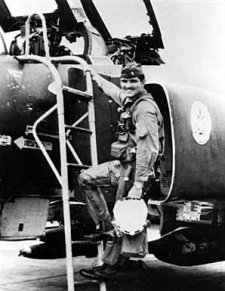
After high school, Lance attended the United States Air Force Academy in Colorado Springs, Colorado. While there, he played football for three years before leaving the team to concentrate on his academic studies during his final year. Four years of rigorous studies, military instruction and mental toughening only strengthened his commitment and dedication. Upon graduating, he was commissioned as a second lieutenant and began pilot training with the goal of becoming a fighter pilot. When he had completed training, his orders assigned him to the 480th Tactical Fighter Squadron, flying F-4 Phantoms in South Vietnam.

Arriving in South Vietnam, Lieutenant Sijan was immediately thrust into the deadly environment of flying a fighter aircraft in combat. One of the targets Lance often bombed was the Ho Chi Minh Trail, the jungle pathways between North Vietnam and neighboring Laos the North Vietnamese used to move soldiers and supplies to the south. It was a high threat area, and oftentimes not all of the planes returned. By early November 1967, he had completed nearly fifty-two missions, and because of the high attrition rate, each day he mentally and physically prepared himself to evade capture and survive if he had to eject over enemy-occupied territory. His training was soon put to the test.

On the evening of November 9, 1967, Lt. Lance Sijan prepared for a familiar bombing mission over Laos. Boarding an F-4 Phantom as the aircraft’s rear cockpit pilot, he took off with Lt. Colonel John Armstrong. Initially, all went as planned, but as the plane reached the target, North Vietnamese antiaircraft artillery filled the sky. Missing the target on the first pass, Colonel Armstrong was in the middle of his second pass when an explosion rocked the aircraft. At five hundred miles an hour, Lance barely had time to eject as the plane literally disintegrated around him. As his parachute opened above him, Lance prepared himself to go from the high tech world of a fighter cockpit to a prehistoric, inhospitable jungle world. Moments later he tore through the triple canopy forest and smacked a hard limestone karst formation that jutted from the jungle floor; immediately, he was knocked unconscious. When he woke up, he discovered his left leg broken below the knee, three dislocated fingers on his right hand, multiple deep cuts on his forearm, and a severe head injury, resulting in a concussion.

Despite his injuries, Lance remained optimistic about being rescued and attempted to direct the rescue aircraft to his exact location. In radio contact with rescue pilots, he gave clear and precise information as he discussed his situation. Unfortunately, due to rugged terrain and enemy troops in the immediate area, the initial rescue operations failed. Now stranded in the Laotian jungle, Lance evaded capture and continued to coordinate the rescue attempts with his survival radio. Several days passed and neither the Americans nor the North Vietnamese found the young lieutenant. Meanwhile, he was slowly dying of thirst.

Finally, Lance decided he had no choice but to crawl through the jungle to find water. First, however, he had to construct a temporary splint for his leg using his meager supplies. Having done so, he began the laborious process. Continually slipping from consciousness, it took him nearly a week just to crawl six hundred yards. As he crawled, he chewed the leaves of fern bushes as well as green leeches and white beetle grubs. At last, he found a small spring and quenched his thirst. Satisfying that need, he continued to crawl, often until exhaustion overcame him. He hoped to contact his fellow Americans and arrange for a rescue. Over the next six weeks, Lance struggled through the jungle, pausing long enough only to drink a little water. He was alone, badly injured, and slowly dying — but he was not broken.

Forty-six days after he was shot down, on the morning of December 25, 1967, North Vietnamese soldiers finally captured Lance Sijan. A group of soldiers guarding a truck convoy discovered him lying in the middle of the road. The North Vietnamese transported him to a makeshift aid station and holding area and fed him small quantities of food. Despite having little strength, several days later Lance managed to overpower his guard, take the guard’s weapon, and drag himself into the nearby jungle. The North Vietnamese immediately set out to recapture him and succeeded not long after, severely beating him for his escape. Not taking any chances this time, the guards imprisoned him in the “Bamboo Prison” just outside of Vinh, North Vietnam. At the new prison, Lance was deprived of medical attention. Two American cellmates cared for him, but his physical and mental health began to deteriorate. He knew he was growing weaker, but he continued to attempt escape from the new prison. Each time, he was intercepted and savagely beaten. The North Vietnamese then moved him one more time.

In early January 1968, Lance and his two cellmates were transported to Hoa Lo Prison, the infamous Hanoi Hilton. By the time he arrived, Lance was near death, but even in his helpless state he resolved to plan one last escape attempt. Each time his companions were escorted to the interrogation room, he insisted they observe guard movements and possible exits out of the prison. He also tried to make his own attempts, only to be stopped by his friends. His continued willpower to survive despite his desperate condition amazed the other POW’s. Lance’s defiant spirit never wavered, but even unquenchable resilience could not heal the physical trauma that had been inflicted on him. On January 22, 1968, alone in his prison cell, Lieutenant Lance Sijan died of pneumonia, untreated wounds, and malnutrition. He finally attained his long sought freedom.

Lance Sijan may have died in North Vietnam, but the country he had so gallantly served did not forget his memory. We know his inspiring story because of the determination of his fellow POW’s to ensure his legacy and honor his sacrifice. Eight years after his death, in March 1976, President Gerald Ford awarded the Congressional Medal of Honor posthumously to Lance Sijan. He was the first graduate of the Air Force Academy to win America’s highest award for bravery. Neither did the Air Force Academy forget his sacrifice. Today, there is a dormitory named after him, and cadets learn the compelling details of his life. The United States Air Force also created the prestigious Lance P. Sijan Award to honor individuals who demonstrate the highest qualities of leadership. The award is a fitting tribute to a man who endured unbearable agony but never lost his fighting spirit. That same spirit should inspire all Americans to follow Lance Sijan’s example and persevere until the very end.

2 Comments

Filed under Uncategorized

Her Eyes Have Seen the Glory

Image

Oftentimes we think that the only people that can significantly contribute to a cause are those who are directly involved in the action. The truth is, we are all blessed differently, and we can all make a difference. During the Civil War, there was a woman who used her gift for poetry to issue a call to battle in the name of human freedom. Already involved in her own way in the cause of freedom, she now wanted to inspire others to do the same. Unbelievably, her simple poem became an anthem for the Union armies, and its author became a national celebrity. Her name was Julia Ward Howe. This is the story of how she composed “The Battle Hymn of the Republic.”

Julia Ward Howe had a skill for writing that she cultivated throughout her early life. As the great-grandniece of the Revolutionary War patriot Francis Marion, the “Swamp Fox,” and a descendant of several prominent Rhode Islanders, Julia developed a love of music and poetry at an early age. She even published her first collection of poems at age fourteen. As she matured into womanhood, she continued her writing and met such leading literary figures as Henry Wadsworth Longfellow, Ralph Waldo Emerson, and Charles Dickens. It was Henry Longfellow who introduced her to her husband, Samuel Gridley Howe, a physician and reformer known for his work educating the blind. Julia continued to write and publish her poems despite her husband’s opposition. Over the years, the couple experienced several turbulent periods, but they united in their opposition to slavery. In 1859, the two met and helped finance John Brown’s raid on Harper’s Ferry, in what is today West Virginia. After the raid’s failure, it became evident that military conflict between the North and the South was inevitable.

As the Southern states began to secede, Julia watched as many Northerners advocated forcing the states back into the Union without interfering with slavery. After Southern troops fired on Fort Sumter on April 12, 1861, the entire country was aroused with hostility. Thousands of Northern citizens rushed to enlist in the Union army. They were afraid that the war would end quickly, and they wanted to teach the Southerners a lesson. Northerners everywhere rallied to the call, but not all that were willing were able to take up arms. Some were old men who would have to remain behind the lines, but the majority were women. Some women became nurses or provided medical supplies to hospitals. Others followed the armies on campaigns, and a few even secretly joined the army as “men.” Knowing she could not do any of these, Julia Ward Howe would do what she did best, and in the process, she would make a contribution more lasting than even she imagined.

As one of those too old to fight, Dr. Samuel Howe offered his medical experience to the Union army. He was selected as a member of the new sanitary commission ordered to inspect the Union camps. Julia travelled to Washington, D.C. to join him at the start of November 1861. Looking out the window of the passing train, Julia observed the growing number of soldiers and realized that she would not witness the death or the maiming of her husband or sons in battle like so many other women. Still, she wanted to do her part in the war. Arriving in Washington, she settled into her room at Willard’s Hotel, the city’s most prestigious hotel. Throughout the city was the newly created Army of the Potomac. The soldiers spent most of the time drilling, but they also spent long periods in camp. A popular pastime for many of those in camp or marching was singing. The air was often filled with familiar tunes, including “John Brown’s Body,” a song that carried religious overtones.

In addition to the soldiers’ training, the new army commander, George B. McClellan, often held grand reviews of the army. At these spectacles, Washingtonians often journeyed into the nearby countryside to watch them perform military maneuvers. It was a grand sight to see the soldiers bedecked in crisp blue uniforms with shiny new muskets and rifles in their hands. Many of the observers expected the soldiers to soon march out of Washington and head south to end the war. One day, one of those spectators was Julia Ward Howe.

On the afternoon of November 18, Julia and several companions attended a grand review of the army. Like others, she was greatly impressed by the soldiers. Returning to the city later that afternoon, she and the others with her began singing several army songs they had heard. As they sang “John Brown’s Body,” many of the soldiers marching nearby joined in with the chorus that proclaimed Brown’s “soul is marching on.” As the song ended Reverend James Freeman Clarke, one of Julia’s companions, made the observation that she should write new lyrics for such an inspiring tune. Julia responded that she had often considered writing a new version, but the lyrics had not come to her yet. The group arrived back in the capitol, and Julia returned to her room at the hotel.

She would later tell the story that she woke up the next morning around twilight. As she was waiting for dawn, words started flowing through her mind. She had soon worked her way through all of the stanzas, but she was afraid of waiting to the morning in case she forgot the words. To prevent such a loss, she immediately got up and sat down at her writing desk. She grabbed a blank sheet of paper and a pencil stub. The words flowed from her mind onto the page before her without any conscious effort. When the poem was finished, Julia returned to bed with the thought that “I like this better than most things I have written.” As often happened, she woke up later with no memory of the words, but she saw that the sheet was on the desk with each of the stanzas written down.

When she had penned a fresh copy of the poem, Julia presented the poem to the popular magazine, Atlantic Monthly. Having already published some of her earlier works, the magazine paid Julia five dollars and published it on the front page of the February 1862 edition. The poem was given the title “The Battle Hymn of the Republic.” It was set to the well-known tune of “John Brown’s Body” and has many similarities to that song. Read and sung by people throughout the North, it reflected the attitude of many Northerners that the war, on a deeper level, was essentially a religious crusade for America’s national salvation. As the poem’s popularity spread throughout the country, it quickly became the anthem of the Union cause.    

It would later be observed that the lyrics were almost a message from God himself describing his obvious favor with the Union cause. He seemed to be directly speaking through Julia’s numerous biblical references, reaffirming many Northerners’ belief in the sacredness of the struggle. Howe’s words specifically related Christ’s death for men’s sins to the soldiers’ deaths for men’s freedom. Other observers commented that the poem represented an even larger contest than just the North versus the South; rather, it represented the universal struggle of good against evil. For those in uniform, the clarion call of those words provided motivation for and a moving testimony to their sacrifice.

“The Battle Hymn of the Republic” brought Julia Ward Howe unbridled popularity, but it did not keep her from continuing in her work. She wrote several more poems, earned success as a lecturer, involved herself in the women’s suffrage movement, and even originated the idea for Mother’s Day. Despite such successes, nothing brought her greater fame than “The Battle Hymn of the Republic.” After she died, a crowd gathered in San Francisco, California and sang the song she had written. Since then the song has been sung and played in countless settings — inaugurations, political conventions, funerals, memorial services, movies, and so many more. The words have been used in numerous book titles and have appeared frequently in speeches and sermons, particularly those of Dr. Martin Luther King, including the sermon delivered the night before his assassination. Quite literally, the influence of the song and its lyrics are endless. Julia Ward Howe set out to do her part for the Union cause — what she really did was to inspire a nation for all time.

2 Comments

Filed under Uncategorized

British Soldier, American General

Image

The fight for freedom is not limited by geographical boundaries. Those who are friends of liberty may come from the most unexpected of places. Perhaps no event better demonstrates this than the American Revolution. Unlikely though it might seem, some of America’s strongest supporters were British, such as the statesman Edmund Burke. One of the most ardent defenders of the American cause was a Continental Army officer who had served in the British army for sixteen years. He then took up residence in America. When war erupted, he chose to stand with the Americans and led an American military expedition against his former comrades. His death in battle transformed him into an American hero. His name was Richard Montgomery. This is the story of his faithful service to his adopted country.

Richard Montgomery was an unlikely choice for an American hero. He was born into an Irish aristocratic family with a proud military heritage. His father was a former British officer who served in Ireland’s Parliament. Richard received a classical education before he attended the prestigious Trinity College in Dublin. After two years however, he decided to pursue a military career. With his father’s financial backing, he was commissioned a British ensign at the age of eighteen and eventually rose to the rank of captain. He saw action in the French and Indian War at Louisbourg on the Canadian coast, in the Lake Champlain valley of upstate New York, at Montreal, and in the Caribbean. When the war ended he returned to Britain. While back home, he grew sympathetic to those who challenged unfair British policies. In 1771, he failed to gain a long-desired promotion to major and resigned in protest. Looking for a fresh start, he immigrated to New York and settled down as a farmer. In 1773, he married Janet Livingston, the daughter of a prominent New York Supreme Court judge.

Despite his desire to live a quiet life, he seemed to realize that it would not last. There is a story that one night in late 1773 his wife Janet woke up from a nightmare. She told him she had dreamed he was killed in a sword fight with his brother. In response, Richard told her he had always known his happiness would not last forever, but he was determined to enjoy his life while he was still able to. He was soon a respected member of New York society, having established himself as a wealthy gentleman. The repressive British response to the Boston Tea Party, however, convinced Montgomery that American liberty was in danger. By the end of 1774, it was clear that he intended to support America in the coming struggle.

When word of the bloodshed at Lexington and Concord reached New York, Montgomery concluded he had no choice but to defend America against Britain. Even though he had only lived in New York for three years, he was chosen to serve as part of the New York Provincial Congress in May 1775. As he participated in military discussions, Richard continued to hope for reconciliation between the colonies and Britain. Despite such hopes, he watched as military action was taken against British outposts, like New York’s Fort Ticonderoga. At the same time, the Continental Congress began appointing military officers for the new American army. In June 1775, the Continental Congress appointed Montgomery as a brigadier general. George Washington, on his way to command the Continental Army at Boston, personally delivered the commission to Montgomery. Despite his initial reluctance to serve, Montgomery decided to set aside his reservations and accept the commission.

As an American officer, Brigadier General Montgomery served as second-in-command of the American Northern Department under Major General Philip Schuyler. He soon received orders from the Continental Congress to make preparations for an invasion of Canada. As he studied the military situation, Montgomery understood an invasion would demonstrate American strength and resolve. He realized though that America had to maintain control of Lake Champlain, which could serve as an invasion route for either the Americans (northbound) or the British (southbound). Furthermore, he also knew that in order for the invasion to succeed, the American army required proper discipline. Montgomery immediately began to train the soldiers and quickly gained their trust. His work was paying off, but military necessity dictated that he immediately launch the invasion or risk its failure.

In the last days of August, Richard Montgomery launched his expedition to seize control of Canada. With him were seventeen hundred soldiers, five cannons and two mortars. After several days of marching, he and the army reached the Canadian town of St. Johns, the first major objective of the invasion. The first attacks against the town failed, and Montgomery had to resort to a siege. After forty-eight days, the British finally surrendered. Montgomery and his soldiers continued their advance and soon captured the city of Montreal, the same city the former British officer had helped capture as a young man. He had successfully captured two cities and many British soldiers, but the prize city of Quebec still loomed ahead of him. He knew such a formidable fortress would require his army’s numerical strength, but enlistments were starting to expire. He was able to persuade nearly eight hundred of his soldiers to stay and help complete the capture of Canada.

At the end of November 1775, General Montgomery left a portion of his army to occupy the captured cities and set out for Quebec with three hundred soldiers. As he advanced, word of his triumphs reached the colonies, and he was quickly hailed a hero and the country’s most successful general. He arrived outside the city on December 2, 1775 and linked up with another American force led by Colonel Benedict Arnold. As the senior officer, Montgomery assumed command of the combined forces and made preparations to capture the city. Hoping to force the British to surrender without an infantry assault, Montgomery launched an artillery bombardment, but the British remained in place and returned the Americans’ fire. There was now no choice but to attack. As the days passed, however, Montgomery became convinced that the city could be taken and victory assured. He outlined the attack for his officers and urged them on with a Latin saying, “Fortune favors the brave.”

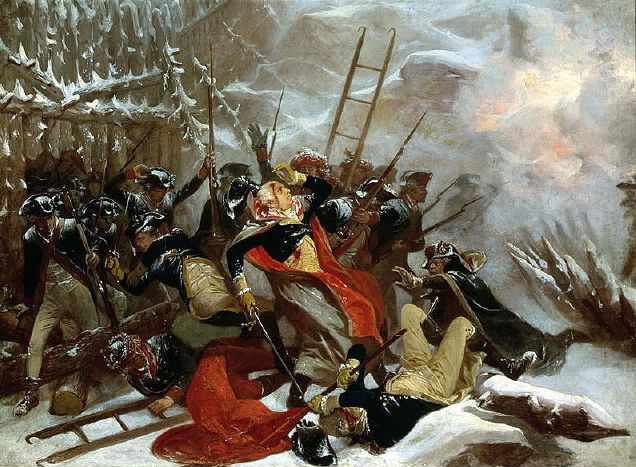
At 4:00 a.m. on December 31, 1775, the American attack began. The soldiers charged through a blinding snowstorm and over large chunks of ice and snow-covered rocks. With Montgomery in the lead, they finally reached the British barricades just before dawn and began to enter the city. Advancing, the general saw a two-story blockhouse in front of him. Believing it to be empty, Montgomery ordered his soldiers to charge the building. The attack was instantly met by British artillery and musket fire. Among those who fell in the first volley was Brigadier General Montgomery. He was hit multiple times in the thighs, groin, and face and died instantly. His body was found by the British and buried with honors. He would never learn that General Schuyler wrote to him that very day to tell Montgomery of his promotion to major general.

Word of Montgomery’s death quickly spread throughout the colonies. The shock and mourning that followed cemented his position as an American hero and martyr. To his countrymen, though born in the British Isles, he was the epitome of an American patriot who gave his life for his country. Over the next few months and years, books, plays, and paintings helped preserve his heroic memory among Americans. Nearly forty-three years after he died, his widow Janet had her husband’s body removed from Quebec and returned to New York. According to some, the funeral procession was the grandest seen since George Washington’s death. General Richard Montgomery’s memory had not been forgotten, nor should it be today. Due to his death early in the Revolutionary War, however, few Americans know his name. But let there be no doubt, a truer friend of the cause of liberty never lived than Richard Montgomery — British by birth, American by faithful service.

1 Comment

Filed under Uncategorized

His Brother’s Keeper

Image

In the biblical book of Genesis, after Cain murdered his brother Abel, God asked him where his brother was. Cain asked in return, “Am I my brother’s keeper?” For him the answer was obviously “No,” but for another brother from another time, the answer was a resounding “Yes.” During the Vietnam War, this brother willingly risked his life and emotional welfare to protect his brother. Had it not been for the love of a brother, Americans might have never heard of the great tennis player, Arthur Ashe. This is the story of how Johnnie Ashe was Arthur’s keeper and protector.

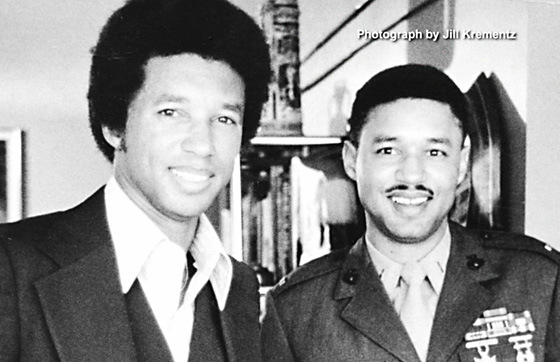
Arthur Ashe and his brother Johnnie each loyally served their country. Arthur grew up in the segregated city of Richmond, Virginia as the oldest son of an African-American laborer. His mother died from pre-eclampsia just before his seventh birthday, which left his father to raise him and his younger brother. Due to his slight build, his father kept him from playing football. Instead, young Arthur took up the predominantly white sport of tennis. He played at his high school in Richmond but soon moved to St. Louis where more opportunities opened to him. While there, Sports Illustrated recognized him for his performance. After graduating high school, he received a tennis scholarship to UCLA where he was the first African-American selected to join the U.S. Davis Cup Team. He also won the NCAA singles title. At UCLA, he joined ROTC and pledged himself to active military service. Later he received his Army commission and was assigned to the United States Military Academy at West Point where he was a data professor and the head of the tennis program. At the time, he was ranked number two in the sport. His brother Johnnie, meanwhile, was serving as a Marine in Vietnam.

It was 1967, and nearly four hundred thousand Americans were fighting the North Vietnamese communists. Over eleven thousand casualties had occurred. President Lyndon B. Johnson told the American public that the triumph of freedom over communism required the sacrifice of young Americans in the struggle. Like many families, the Ashes were expected to do their part. The two brothers were in the military, but only Johnnie was serving “in country,” as it was called. This was in accordance with an existing Department of Defense regulation, which restricted combat tours to one family member at a time. Both brothers realized that Arthur would likely be deployed when Johnnie’s combat tour ended. In a television interview, Arthur was asked if he ever considered not serving as a protest, but he responded that he had been born in America and believed every American had the responsibility to serve in the military.

Despite his willingness to serve, Arthur Ashe had not yet experienced war first-hand. Johnnie described him as having “a gentle spirit.” After experiencing combat and its hardships, Johnnie did not believe that Arthur would adapt well to the rigors of combat in the jungles of Southeast Asia. Johnnie was close to finishing up his tour of duty and began to consider Arthur’s fate. He had cheered as his brother climbed toward the pinnacle of the tennis world. He knew Arthur had virtually limitless opportunities because of his tennis career, and he believed Arthur should be able to embrace those possibilities. All would be jeopardized if Arthur was sent to combat.

Johnnie understood that military service in Vietnam risked not only Arthur’s death or injury but also the loss of precious time for Arthur to attain his dream. Johnnie determined to do anything he could to keep Arthur out of harm’s way and to safeguard his future. In reality, there was only one option open to Johnnie though. He decided on his course of action before going to see his commanding officer. Johnnie described how he was Arthur Ashe’s brother and how Arthur might be sent to Vietnam unless he volunteered to serve another tour of duty. After listening to Johnnie, his commander told him that he was a good Marine and that America needed good Marines to stay and finish the fight.

That was the end of the matter. Johnnie Ashe served another tour in Vietnam, and Arthur remained at West Point. He was able to continue his tennis career because of his brother’s willingness to put him first. Johnnie never told Arthur, or anyone else except his father, about his decision. In 1968, as Johnnie was serving that second tour, Arthur played in his first U.S. Open. He won but was unable to keep the prize money due to his amateur status. Half a world away, Johnnie proudly watched on television as his older brother became the first African-American to win a Grand Slam title. Johnnie continued to serve in the Marine Corps, but like many soldiers returning from Vietnam, he had to deal with the war’s unpopularity. After bravely serving his country in wartime, Johnnie experienced the full vitriol of the anti-war movement, even relating how people came up and spit on him as he was getting off the airplane when he returned home in uniform. He willingly endured the emotional turmoil that followed his service in order to protect his brother from experiencing the same thing.      

After he won the U.S. Open, Arthur Ashe went on to have a phenomenal tennis career. He won both the Australian Open and Wimbledon and was later named captain of the U.S. Davis Cup team. He also became an outspoken advocate for civil rights, for education, and, after contracting HIV following a blood transfusion during heart surgery, for victims of the AIDS virus. He would eventually find out what his brother had done for him, and he would often remind his daughter of her uncle’s devotion. Arthur Ashe succumbed to the ravages of AIDS and died in 1993. Twenty years later, in 2013, Johnnie would receive the Heart of Arthur Ashe Award for his selfless actions. Johnnie, however, humbly expressed his desire that his service be remembered as nothing more than “a footnote in Arthur’s life.” While it is the name of Arthur Ashe that people remember, it can never be forgotten that the love and sacrifice of Johnnie Ashe made him, in the truest sense, his brother’s keeper.

4 Comments

Filed under Uncategorized

A Southern Man With a Plan

Image

In order to defend one’s beliefs, it is sometimes necessary to defy the social conventions with which a person has lived for many years. It takes courage, and it takes vision. Today, nearly one hundred and fifty years after it ended, the American Civil War is often seen as a struggle between slavery and emancipation. It is known that the Union fought for the slaves’ freedom, but there was a brief moment during the war when the South might have also offered emancipation. In early 1864, one Confederate general offered a proposal that would give African-American slaves their freedom if they fought for the Confederacy. In doing so, he went against the beliefs of his adopted society. His name was Patrick Cleburne. This is the story of his visionary plan to win the war for the Confederacy.

Patrick Ronayne Cleburne never quite seemed in the mainstream of conventional society. He was born into the Protestant upper class of Ireland and enjoyed a different upbringing than most Irish Catholic laborers. He had the further distinction of being an Irishman who served in the British army and rose to the rank of corporal. After three and one half years, he left the army and his home and immigrated to America. Arriving in New Orleans, he spent a short time in Cincinnati, Ohio before moving to Helena, Arkansas. There he worked as the manager of a drugstore before pursuing a career as a lawyer. He also helped to start a local newspaper as he became more involved in Southern politics. He did not own any slaves and did not appear to hold strong convictions about the institution. Yet, as the Civil War began, this Irish immigrant declared, “I am with Arkansas….”

After Arkansas seceded from the Union, Patrick Cleburne joined the Confederate army with a belief that the Union was waging an unjust war. He was immediately chosen to command his regiment and quickly advanced to brigade command. He distinguished himself in action at Shiloh and within a year commanded a division in the Army of Tennessee. At the battle of Chattanooga in November 1863, he and his division held back the Union advance and allowed the rest of the army to withdraw. To many in the South, he was a hero. General Robert E. Lee called him “a meteor shining from a clouded sky,” and Confederate President Jefferson Davis called him the “Stonewall of the West,” comparing him to the legendary Stonewall Jackson. Despite his service to the South, Cleburne was not a native Southerner and did not truly understand the Southern culture. If he had, he would have known that any attempt to change the Southern mindset regarding slavery was doomed from the start.

From the beginning of the war, Patrick Cleburne was convinced that the South fought for independence and self-government. He had shouldered a musket to prevent the Confederacy’s military conquest by the North. He believed that Southerners should live under their own laws, a concept embodied in the states’ rights argument. In his mind, the North’s call for emancipation was a calculated decision to justify the invasion and subjugation of the South. He could not help but observe, however, that emancipation aided the North’s numerical superiority while the South’s troop strength dwindled through irreplaceable attrition. The loss of men would be the Confederacy’s ultimate undoing. In the late winter of 1863, he studied the situation and the alternatives available to the country. For him, the answer to the South’s problem was self-evident.

In December 1863, Patrick Cleburne declared to his officers that “a crisis was on the South,” and he had a duty to help avoid it. He then spoke of an untapped reservoir of manpower. He began writing a document that grew to more than two-dozen pages and was revolutionary in scope. In it, Cleburne boldly advised that the South should arm the African-American slave population residing in the individual states. He had seen how former slaves fought bravely in the Union army. Cleburne argued they would fight just as well if led by Southern officers. He understood that the slaves would need an incentive to fight. For that reason, he recommended that any slave who took up arms be granted their freedom and the freedom of their families. Cleburne was convinced that such an act would benefit the Confederacy by destroying the Union’s declaration that it fought for emancipation. Instead, it would show Northerners to be nothing but invaders.

When he had finished writing, Cleburne showed the proposal to some of his officers. Those who read it were skeptical and tried to persuade him against presenting it. Cleburne would not be dissuaded though and offered it to his brigade and regimental officers. He obtained greater support from them and decided to offer it to his fellow commanders in the Army of Tennessee. He made the presentation on the evening of January 2, 1864. He began by reminding his listeners that the Confederacy had waged war for nearly three years and that the enemy had conquered one-third of the country. He gloomily predicted defeat if the scenario continued much longer. He then insisted that slavery was a burden that prevented military and political success. The logical solution, Cleburne said, was to enlist the slave population in the army. He expressed his belief that, faced with a choice between losing independence and losing slavery, most Southerners would “freely give up the latter — give up the negro slave rather than be a slave himself.” He ended his presentation by saying that he and the officers under his command considered it “a plan which we believe will save our country.”

The immediate reaction of many of his listeners showed their disbelief in and hostility to the plan. To some, the plan compromised the very values of the society that Cleburne had pledged his sword to defend. One officer even implied that it was treason against the South and sounded more like the calls of Northern abolitionists than a supposed Southern patriot. To these Southern officers, the arming and freeing of the slaves stood in direct contrast to professed views about African-Americans. To them, Southern independence and slavery were inseparable. The Confederacy could not have one without the other.

Patrick Cleburne listened to the attacks on his plan and was extremely disappointed that the officers could not see the validity of his argument. The commander of the Confederate army understood how explosive Cleburne’s proposal was and ordered that there be no more talk of it. Still, one of the officers sent news of the proposal to the Confederate government in Richmond, Virginia. President Jefferson Davis saw how controversial it would be if word of such a topic leaked out to the Southern people. He immediately ordered that there be no further consideration of or discussion regarding the plan. Any possibility for Southern emancipation ended there.

Despite his disappointment and the censorship of his plan, Patrick Cleburne continued to serve the Confederacy. Throughout the summer of 1864, his division fought with distinction in the long struggle to save Atlanta, Georgia. Then he took part in the ill-fated invasion of Tennessee. As he led his men against entrenched Union troops during the late afternoon of November 30, 1864, Major General Patrick Ronayne Cleburne was killed in battle at Franklin, Tennessee. Little could he have known that four months later, in March 1865, with Union forces closing in, the Confederate government would finally pass a law providing for the arming of slaves. Though the act came too late to save the South and there was no mention of emancipation, the act appeared to be a vindication of Cleburne’s beliefs. Patrick Cleburne, a fearless and devoted commander in battle, also had the courage and vision to challenge the accepted thinking and to push for what he saw was right. Had he been listened to, the course of the war, and even its outcome, might have been fundamentally altered.

1 Comment

Filed under Uncategorized

An American Nobleman

Image

Throughout time, courageous men and women have risked all that is dear to them for a higher purpose.  One such man was a young French noble during the American Revolution.  His actions in battle transformed him into one of the most beloved American commanders.  He had abandoned his life as an aristocrat to cast his lot with the new United States and the “glorious cause” of liberty.  In doing so, he risked his family’s name, his wealth and his very life. Yet, he is remembered today as one of the country’s most ardent defenders.  His name was the Marquis de Lafayette.  To Americans, he has always been simply “Lafayette.” This is the story of how one moment united him forever with the American cause he risked everything to serve.

Stretching back to the Middle Ages, the Marquis de Lafayette’s family line was filled with French military heroes, including his father who died in battle when Lafayette was only two years old. The deaths of his mother and great-grandfather when he was twelve made him both an orphan and one of France’s wealthiest aristocrats.  Despite his grand position, Lafayette felt ill at ease in court settings.  He soon left for the French town of Metz to complete his military training.  In Metz, the seventeen-year-old Marquis first heard about America’s fight for freedom. As a Freemason, he embraced a belief in the rights of life, liberty and property and determined to join the Americans’ struggle. After conferring with the American representative to France, he departed for America without permission from his own government, which was not yet involved in the war. Landing on American soil, the Marquis vowed that for America he would be victorious or die in the effort. He soon proved his vow was more than mere words.

Arriving in the American capitol of Philadelphia, he expressed his desire to serve the cause of liberty to the Continental Congress.  In response, Congress appointed him a major general.  To quiet fears about his intentions, he told George Washington that he had “come here to learn, not to teach.”  He was soon a part of American efforts to halt the British advance on Philadelphia. On September 11, 1777, the nineteen-year-old Marquis stood with the Americans along the banks of Brandywine Creek. It would be his first taste of combat and would forever link his name with that of the United States of America. Quickly, the fight exploded.

The battle raged as the American army focused its attention on the British center.  Seizing an opportunity, British general Lord Charles Cornwallis led a flanking attack against the exposed American right. Word of the attack spread to Lafayette and General Washington.  Turning to the commanding general, the young Marquis asked if he could help bolster the collapsing flank.  Washington quickly agreed and Lafayette galloped toward the sound of battle.  Minutes later, he reached the scene and took in the confusion. He saw that the British had already crossed the creek and were advancing on the American lines. Astride his horse, he watched as several American officers ordered their men to hurriedly form defensive lines to prevent any further advance.  Wasting no time, British soldiers fired their cannons and muskets as they marched across a broad field toward the American lines.

Lafayette immediately raced to join the other American commanders directing the fight.  Reaching the group of officers, he helped take command of 800 American soldiers.  He directed their fire and proudly stood with them as they faced the onslaught of the Redcoats. As Lafayette was occupied in his efforts, the might of the British attack started collapsing both flanks. With no support on either side, the center of the line also began to give way under the increasing pressure. The Americans began to flee. The battle was turning.   

Lafayette stared in shock as the American soldiers fled in terror and the British followed. It was the moment of truth for the young general.  The Marquis raced to block the flight of the soldiers, but they continued to pour past him in search of safety.  In desperation, he jumped from his horse and began grabbing and pushing individual soldiers into line. At 6 feet, 1 inch tall, he towered over many of them.  All the time he was shouting that they had to stay and hold the enemy back.  He was caught up in the frenzy of battle. The stunned soldiers looked at him. Here was a major general acting like a common company officer or soldier.  They immediately saw in him a general not afraid of standing beside them. Soldiers took heart and rallied around him as he stood firm against the British advance.  Other commanders and soldiers stood as support behind him. The enemy closed to within twenty yards, and the young general finally had to order the men to withdraw to a nearby woodlot.  They had successfully stopped the impending rout of the American army.

As Lafayette stood looking around at the dead and wounded about him, one officer noticed blood leaking from his boot. A British musket ball had torn through the calf of his left leg.  He had shed his blood on American soil in defense of the American cause. Lafayette was soon forced to join the rest of the army as it withdrew from the battle, but blood loss weakened him. The injury had to be bandaged even though the British were close behind.  In stopping, Lafayette was almost captured by the enemy but managed to escape. Despite the wrenching pain he helped restore calm among the panicked soldiers.  Washington soon arrived and ordered his surgeon to tend to him. He even told the surgeon to “treat him as if he were my son.”  It was the beginning of a lifelong father-son relationship.

News of Lafayette’s actions soon spread throughout the country, and the Americans hailed him as a national hero. He quite possibly saved the American right flank, and the army, from destruction.  He was now a valued member of Washington’s command. The young general continued to distinguish himself alongside Washington through the triumphs and tragedies of the Revolution, and he endeared himself to all of America by his selfless and courageous service during the long struggle.  After six more years, the war ended and Britain finally recognized American independence.  It was a bittersweet parting when Lafayette returned to France, but America always remained in his thoughts.

Nearly fifty years later, he returned to the land that he loved in a grand triumphal tour. Among the stops he made on that return trip was a visit to the old battlefield of Brandywine. It was the place where he had first shown himself a defender of America.  He was the pride of the country.  One of his final acts was to scoop some dirt from Bunker Hill, an early Revolutionary battle site, to take back to France with him.  Less than ten years later, the Marquis de Lafayette died and his son, who he had named in honor of George Washington, poured the dirt on his father’s coffin so the old hero would forever be buried under American soil. When word reached America of his death, the House of Representatives and the Senate chambers were draped in black out of respect.  The nation followed suit and mourned the loss of the brave Marquis.  

During that last trip to America, the former American general made a toast in which he said that the union of the states would one day save the world, and he was right. Nearly eighty-five years after Lafayette died, American troops landed in Europe to help save France in World War I. Arriving in Paris, American commander “Black Jack” Pershing sent his aide, Colonel Charles E. Stanton, to Lafayette’s grave.  There Stanton planted an American flag over the Marquis’ grave and said, “Lafayette, we are here.” It would not be the only tribute, however.  Today towns all over America proudly bear his name.  In 2002, by an act of Congress, Lafayette was made an honorary citizen of the United States. The French nobleman who had risked all he had to serve America and the cause of freedom, finally and fittingly became “Our Marquis.” 

Leave a comment

Filed under Uncategorized

Mr. Smith Goes to War

Image


During that turbulent time in our past known as World War II, virtually all young Americans of the “greatest generation,” even the famous ones, were infused with a spirit of patriotism.  For one man, that spirit was more important than his flourishing Hollywood career.  His name was known all over the country, and he had just won an Academy Award.  He felt the call of duty and did not wish to remain safe behind the lines.  He wanted in the fight, but his celebrity status actually stood in his way.  While most Americans remember him for his roles as Jefferson Smith (“Mr. Smith Goes to Washington”) and George Bailey (“It’s A Wonderful Life”), it is sometimes forgotten that he had another title — that of Colonel in the United States Army Air Corps.  His name was Jimmy Stewart.  This is the story of his fight to serve his country.

James Maitland Stewart was born in a small town in western Pennsylvania, raised in a family with a long heritage of serving America and fighting in its wars.  From his earliest days Jimmy yearned to fly, paying for his first airplane ride from his own money while in high school and hooked by the flying bug for the rest of his life.  He wanted to attend the United States Naval Academy, but his father arranged for him to attend Princeton University instead.  At Princeton, Jimmy became involved in acting, a talent that led him first to Broadway and later to Hollywood.  Arriving in Hollywood in 1935, he established himself as a folk hero for his starring role in Mr. Smith Goes to Washington in 1939.  The next year he won an Academy Award for his role in The Philadelphia Story.  In his time off from filming, Jimmy found time to pursue his dream of flying.  This experience came as the war in Europe widened and Hitler’s war machine crushed all resistance.  At night, Jimmy often listened to the CBS radio broadcast, “This…is London,” moved by the desperate struggle.  British actors with whom he was friends began to take part in the war effort and inspired him to do the same.

America was not yet directly involved in the war, but Jimmy Stewart believed that it was only a matter of time.  He would not wait for America in order to decide his own personal course.  Like his father and grandfathers before him, Jimmy would do his part to defend American ideals and stop tyranny in its tracks.  And why should he not get such an opportunity?  After all, he had both a private and commercial pilot’s license with over 300 hours of flying time, more than many pilots in the Army Air Corps.  He was soon to discover however that merely wanting to serve his country was not enough.  He would be faced with many obstacles both prior to and following his enlistment before he reached the front lines of the war.  In effect, Jimmy Stewart had to wage his own personal war to join his comrades in the struggle for freedom. 

In 1940, a full year before the Japanese attacked Pearl Harbor, Jimmy Stewart committed to enlist in the United States military.  It was a personal desire as well as a national responsibility, thanks to the Selective Service Act.  Roadblocks began immediately.  First, his preparation to register for the draft was not met with approval by the head of MGM Studio.  After all, the American press and public alike adored him.  MGM did not want to take a chance on losing him.  Stewart was offered a number of opportunities including choice roles, contract revisions and even time off to help support the war in a civilian capacity.  Nothing could entice Stewart to waiver from his commitment.

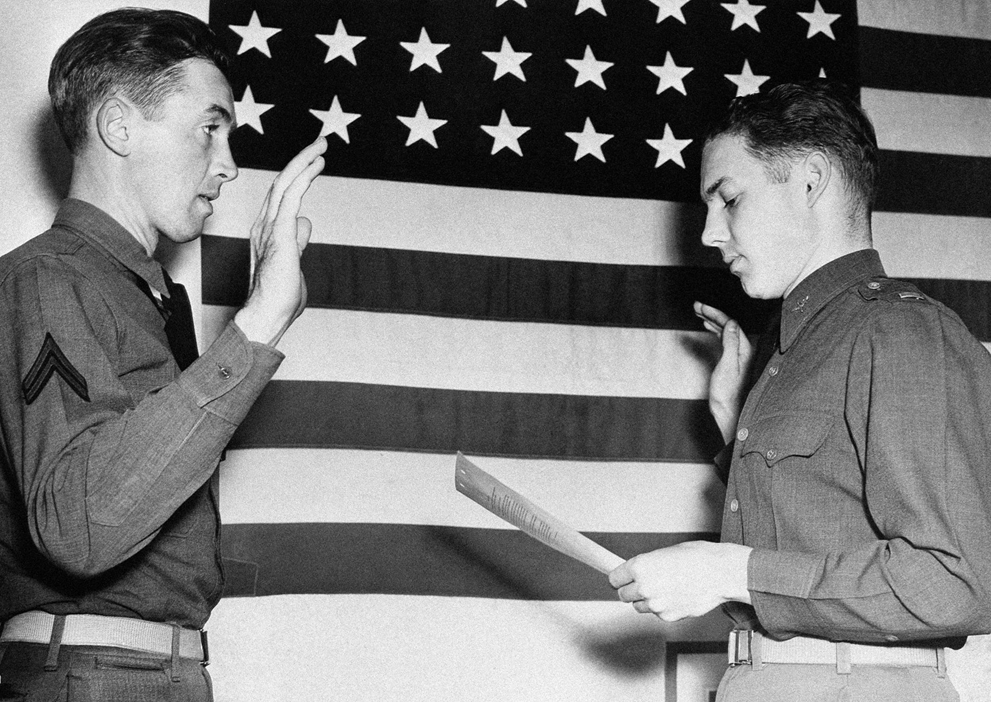
As required, he registered for the draft and was called in for his physical exam, but here was his second roadblock.  He failed his physical exam when he was found to be ten pounds underweight.  His plans for military service might have ended there, as his boss at MGM hoped, but Jimmy would not be deterred.  Instead, he immediately chose to appeal his rejection and was ultimately accepted the second time.  He was inducted into the Army Air Corps as an enlisted man a little more than eight months before Pearl Harbor, learning the finer skills of KP (kitchen patrol), drill, and guard duty.  His greatest hope however was to be actively involved in combat.

After finally being accepted into and finishing his initial flight training and officer examinations, Jimmy Stewart was commissioned a second lieutenant and earned a set of pilot wings.  He had taken the first step toward his ultimate goal and was ready to confront the second.  He was determined to serve in combat overseas, but he was just as resolved that he would not use his stardom to pull strings.  All he wanted was to be treated like any other American serviceman.  At first it seemed to be going according to plan as he was assigned to training in the B-17 Flying Fortress.  Completing his B-17 course in early 1943, Jimmy awaited his combat assignment, but it was not to be.  Lt. Stewart was assigned as an instructor of B-17 pilots in Boise, Idaho, the only pilot in his class to receive those orders.  Someone in the chain of command did not want the responsibility if he was shot down and captured or killed, and so his personnel file was given a hold order, meaning he would not be going overseas.  It looked like Jimmy would spend the war in Boise.

Despite his disappointment, Jimmy settled into the task of training the new pilots.  He intended to earn combat duty with his abilities, not his celebrity status or influence.  He performed well in his duties and watched as his students prepared to graduate and go overseas.  Jimmy was thirty-six years old, and it still looked like he was going nowhere.  Then he heard a rumor that he might be reassigned to selling war bonds or making training films.  Captain Jimmy Stewart could no longer passively await his assignment.  For the one and only time he would ask for a favor, Jimmy went to see his commanding officer and begged for a transfer to combat duty.  Understanding Stewart perfectly, his commanding officer personally arranged for Jimmy’s transfer to the 445th Bomb Group to fly the B-24 Liberator.  The hold order on the personnel file was essentially ignored; no one ever discussed the matter.  Soon Jimmy Stewart was on his way to England where the 445th became part of the famed Eighth Air Force.

Just as he wanted, Jimmy Stewart was now in active combat against Nazi Germany.  As a squadron commander, he flew in many of the early bombing campaigns made on German cities by the 445th Bomb Group.  Leading some of the most dangerous missions himself, he became popular with the individual crews and his superiors.  He did not give interviews or stand aloof from his fellow warriors.  He quietly went about his business.  Soon he was promoted to Group operations officer and transferred to the 453rd Bomb Group.  In his new position, he briefed the crews prior to each mission and gave them clear and concise instructions regarding the objective targeted for bombing and the associated threats.  He would serve as the Group operations officer through the pivotal weeks leading up to and following the Allied invasion of Normandy on D-Day.  Just after that momentous event, Jimmy transferred to the Second Combat Wing Headquarters where he served as executive officer, operations officer, chief of staff, and wing commander.  It was his job as wing commander after the war to bring the flyers back to America and oversee their mustering out.  He served twenty-two months in the European theatre of operations.  It was then his turn to go home.

After the war ended, Jimmy Stewart returned to Hollywood to renew his acting career, beginning with It’s A Wonderful Life.  He also continued his military service in the Air Force Reserves, rising to the rank of brigadier general and proudly serving over 27 years.  He would occasionally return to England for reunions with his old comrades.  Although Jimmy Stewart was one of the most famous of Hollywood actors, he was so much more than that.  Much like the modest characters he often portrayed, in real life he was a true American hero — one who prized service to his country so much that he was willing to fight for that privilege.

2 Comments

Filed under Uncategorized

The Last Fight

Image


There is probably no more important personal responsibility than providing for one’s family.  At times that may even mean using the last of his or her strength.  In the early 1880s, there was an American hero whose family faced a perilous situation.  He had been reckless with his finances and now faced ruin at the same time he was dying of cancer.  He was driven to ensure the welfare of those he left behind, so he penned a successful autobiography that told of his rise to become general and President of the United States.  He was Ulysses S. Grant.  This is the story of his final battle to save his family.

Ulysses S. Grant enjoyed one of the most remarkable careers of any American.  In seven years, he rose from complete obscurity to the heights of prominence.  As the son of a poor Ohio family, he had an undistinguished record at the United States Military Academy at West Point.  His later problems with alcohol forced him to resign from the army.  Failing at everything, he was reduced to working as a clerk in his father’s leather goods shop.  Then came the Civil War.  He rejoined the army and quickly attained fame for his hard-fought victories at Fort Donelson, Shiloh, Vicksburg and Chattanooga.  In 1864, Lt. General U.S. Grant became the commanding general of the army and led the Union to victory over the Confederacy.  After the war, he served as four-star General of the Army and Secretary of War.  In 1868, Ulysses was elected President.  By any measure, it was a meteoric rise.    

He did not, however, succeed as well as a politician.  He was honest, but he relied on men who were not.  His two terms were laden with scandals as multiple officials faced criminal indictment for financial improprieties.  The scandals ruined Grant’s presidency.  Leaving office after his second term, he toured Europe and Asia with his wife and son.  In each capitol he was toasted as a true American hero.  Returning to the U.S., he tried to secure a nomination for a third term as President.  Failing to succeed he left politics for good and settled into retirement in New York City.  Unfortunately, his status as a celebrated war hero and President could not protect him from financial loss.

In 1884, Ulysses S. Grant, famed general of the Union, suffered a crippling blow.  He had invested his entire life savings, nearly $100,000, no small fortune in that day, in a bank on Wall Street where one of his sons served as a partner.  The company went bust, and Grant was left with almost nothing.  The head of the bank was eventually convicted of embezzlement and sentenced to prison, but that did little to help Grant or his family.  At one point the general even had to promise his personal sword as security for a loan.  When he could not pay it, he lost the sword.  To help him out, the U.S. Congress passed an act restoring his rank of general.  This allowed him to collect a pension.  Grant knew, however, that such an act of generosity would only go so far in providing financial security for his family.  He needed to find another way.

Unfortunately, at this moment of crisis, Grant learned time was running out for him.  His years of constantly smoking cigars finally caught up with him.  Many Union soldiers remembered seeing him calmly puffing away in the midst of battle.  Doctors now diagnosed him with throat cancer.  Hearing the news, Grant became even more desperate to rescue his family from destitution before he died.  Suddenly, he was presented with a most generous and unexpected offer.

For many years, friends and admirers had been urging him to write his personal memoirs, especially telling his view of the Civil War.  Mark Twain now approached the dying hero with an offer to publish Grant’s autobiography if he would write it.  Grant realized this was his chance to provide a legacy for himself and, more importantly, a fortune for his family.  He set to work immediately.  Through the spring and early summer of 1885, he worked tirelessly on the manuscript even as his condition steadily weakened.  He wrote page after page telling of his West Point days, his early military career and finally his contribution to the Union cause and ultimate victory. 

In mid-June he moved with his family to a cottage at Mount McGregor in the Adirondack Mountains not far from Saratoga.  Not long after settling in, Grant completely lost the ability to speak as the cancer ravaged his body.  All he could do was sit on the porch of the cottage and write.  He was determined not to succumb to the cancer until the task was complete.  He would not leave his wife and children to bear the cost of his personal failures.  In early July he wrote the last pages.  His life story now finished, the former President and general died just a few days later on July 23rd.  His memoirs proved to be a bestseller, selling hundreds of thousands of copies, and earning the family almost $500,000.  The proceeds were more than enough to reestablish the Grant family fortune.

After he died Ulysses S. Grant was buried in the largest mausoleum in North America on Upper Manhattan in New York City.  His legacy as the architect of Union victory in the Civil War continues to this day.  He served as President, but at heart he was a warrior.  Perhaps there was no better proof than his determination to win the fight to finish his memoirs.  He endured the final months of pain and suffering just as he had endured four years of hardship and bloodshed to bring the Union victory in the Civil War.  Providing for his family was, for this man, as much an act of honor as serving the Union he helped preserve.  He did not live to see all the fruits of this personal victory, but Ulysses S. Grant did succeed in his final fight.

2 Comments

Filed under Uncategorized

A Hero’s Fall

Image


The biblical book of Proverbs teaches that pride goes before a fall.  Perhaps no man better exemplifies the proverb than a Continental army officer who was one of the top battlefield commanders during the early years of the American Revolution.  He won distinction in one of the most important battles of that war.  His service earned him the respect and appreciation of his countrymen, including General George Washington.  But then his self-consuming pride led him to commit an infamous act of betrayal.  He is now remembered for his despicable treason rather than for his heroic deeds.  This hero-turned-traitor was none other than Benedict Arnold, the American general that pride destroyed.

From his earliest days, Benedict Arnold felt the need to prove himself.  After watching his father lose respectability due to debts and alcoholism, he worked hard to become a successful druggist and merchant.  He participated in early anti-British protests when his business interests were adversely affected by oppressive changes to colonial laws.  When the Revolution broke out, he assumed command in the Continental army and quickly gained attention with the capture of Fort Ticonderoga in upstate New York.  His fame further increased when he led an expedition through the Maine wilderness to attack the British stronghold of Quebec, Canada.  In the attack he suffered a wound to his leg.  He recovered in time to command an improvised American navy at Valcour Island and turn back an enemy fleet coming down Lake Champlain.  He was probably already America’s best battlefield commander.  Some even called him an American Hannibal, in reference to the legendary Carthaginian general.  Then came his greatest success — the Battle of Saratoga, New York.

The British were advancing down the Hudson River in order to divide the colonies.  The Americans confronted them outside of Saratoga.  In the first of two major actions, Arnold was once again in the thick of the fight.  The heavy fighting forced the British to halt their advance.  Following that first engagement, however, Arnold quarreled with the American commander, Horatio Gates, and was confined to camp.  He was sitting in his tent when he heard the noise of battle as the second engagement began.  Disobeying Gates’ orders, he jumped on his horse and raced to the front of the troops.  He led an attack that ultimately forced the British to surrender.  At this moment of triumph, however, Arnold suffered further injury to the same leg wounded at Quebec.  It is said that when he was asked where he was injured, he answered it was his leg, “but I wish it had been my heart.”  Many people over the years have expressed agreement with this statement.  Had his story ended that day, where he quite possibly saved the Revolution and achieved a victory that persuaded the French to enter an alliance with the Americans, today we would remember him as a heroic officer who gave his life for his country.  His story did not end that day though.  He would be remembered — but not for saving the country.

Arnold underwent a dramatic transformation as he recovered from his wounding.  He had always believed himself underappreciated, even though he was admired by his troops and trusted by George Washington.  He saw incompetent officers rewarded while his own career languished.  He was upset when the Continental Congress promoted several officers ahead of him.  These disagreements continued, and even deepened, after Washington appointed him military governor of Philadelphia.  He also suffered financial problems, which he attempted to correct through his influence and position.  He would face a military trial for his questionable dealings.  A light reprimand from Washington only seemed to push Arnold further away.  Perceived slights became major grievances.  He felt his honor had been impugned.    

As he endured these tribulations, Arnold found comfort in his new wife, Peggy Shippen, a young woman who had been openly friendly with several British officers during their earlier occupation of Philadelphia.  Encouraged by his wife and stung by the wounds to his pride, Arnold began to see himself more and more as a victim.  Finally, Benedict Arnold had had enough.  America’s Hannibal decided to trade American blue for British red.

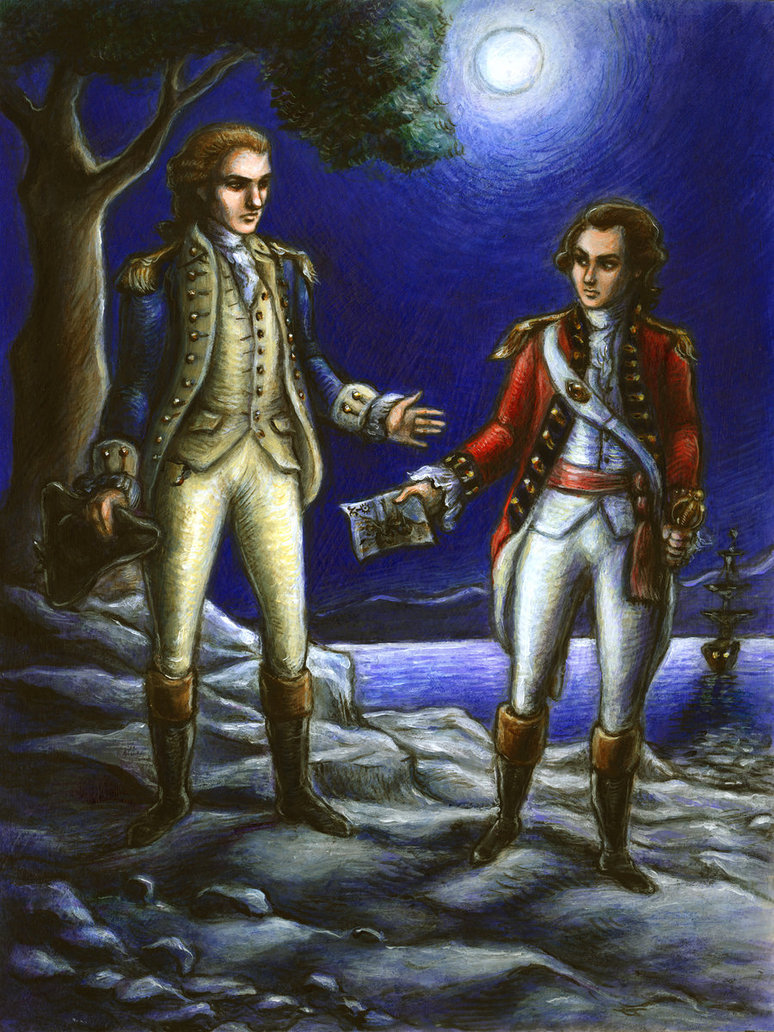
Having chosen his course of action, Arnold began a secret correspondence with Major John Andre, the adjutant general of the British army who had known Peggy well in Philadelphia.  Arnold eventually agreed to secure the capture of a critical American fort in exchange for a large sum of money and, supposedly, the respect of the British, represented by a command in their military.  The fort was West Point, future sight of the United States Military Academy.  At the time it was actually a series of forts strategically located on the bluffs guarding the crucial Hudson River.  As Arnold knew from previous experience, the British desired control of the river so they could separate New England from the rest of the nation and end the war.  He persuaded George Washington to appoint him as commander of West Point.  Arnold assumed his new command at the end of July of 1780 and spent the next two months deploying troops and defenses so as to weaken the forts and allow an easy British capture.

At 1:00 A.M. on September 22, 1780, American General Benedict Arnold secretly met with British Major John Andre.  Arnold handed over the information critical to West Point’s capture.  He also told Andre that George Washington was coming to inspect the fort.  If the British moved quickly, the American cause could be dealt a fatal blow.  Miraculously for the country however, American militiamen, maybe no more than highwaymen, intercepted Andre in civilian clothes on his way back to British lines.  The plans to West Point were found hidden in his boots along with a pass signed by Arnold.  The men took Andre and the information to a nearby American commander.  The commander sent the documents to General Washington and, in an unfortunate development, a message was also sent to Arnold informing him of the capture.  Realizing his plot was exposed, Arnold fled to safety behind British lines in New York.  Within minutes after Arnold’s escape, Washington himself arrived at West Point.  When the commanding general saw the documents, he was shocked and was heard to exclaim, “Arnold has betrayed us!  Whom can we trust now?”

Arnold eventually ended up in England and lived out the rest of his life in disgrace.  As for Major John Andre, the Americans tried and hung him as a spy, then later returned his body to the British who buried him with honors in London’s Westminster Abbey.

Even though America eventually won the Revolution, Arnold’s act was a devastating blow for Washington and the country.  America’s greatest battlefield general had joined the enemy.  Americans would never forget that.  One story even told how the traitor Arnold later questioned a captured American soldier as to what would happen if he, Arnold, were captured.  The soldier replied that the leg that had suffered wounds for the cause of liberty would be cut off and buried with military honors.  The rest of Arnold would be hanged.  The young man was more right than he knew.  Today, on the old battlefield at Saratoga, there is a monument which depicts a leg and which praises the gallantry of the officer who was wounded on that spot in the service of his country.  The monument does not give the name of the officer, but his identity is known to all familiar with the history of the battle.  It is a fitting testament.  Benedict Arnold fought, bled and almost died for his country.  Ultimately however, he allowed his pride to lead him to treason — and to a fall — just as the proverb says.

3 Comments

Filed under Uncategorized